PM Kisan 22nd Installment 2026: ₹2,000 Payment Expected Soon for Farmers

PM Kisan

“Empowering Farmers, Securing Futures – PM Kisan Support Continues!”

Table of Contents

PM Kisan 22nd Installment Update

The PM Kisan Samman Nidhi Yojana continues to be one of the most important financial support schemes for Indian farmers.
The 22nd installment of ₹2,000 is expected to be released in March 2026 as part of the regular quarterly cycle (December–March).

Under the scheme, eligible farmers receive ₹6,000 annually in three installments directly in their bank accounts through Direct Benefit Transfer (DBT). Although the government has not yet announced the official release date, previous payment patterns suggest that the installment could arrive in early to mid-March 2026, once verification processes are completed.

Beneficiary Cleanup Drive

A large-scale verification drive is currently underway to ensure that only genuine beneficiaries receive the benefits of the scheme. Due to this verification, some delays in the 22nd installment are possible.

During the 21st installment cycle, nearly 70 lakh beneficiaries were removed from the list due to:

  • Incomplete or missing e-KYC
  • Aadhaar not linked with bank accounts
  • Land record mismatches
  • Income taxpayers listed as beneficiaries
  • Duplicate entries in the system

So far, the government has disbursed over ₹4 lakh crore through 21 installments to nearly 9 crore farmers across India.

Recent Achievements of the Scheme

The 21st installment of PM Kisan was released by Prime Minister Narendra Modi on
November 19, 2025, in Coimbatore.

During this event, approximately ₹18,000 crore was transferred directly to more than
9 crore farmers.

Launched in 2019, the PM Kisan scheme has become the world’s largest Direct Benefit Transfer program.
The financial assistance helps farmers:

  • Purchase seeds and fertilizers
  • Support education and healthcare expenses
  • Reduce dependency on agricultural loans
  • Improve rural economic stability

Research studies, including one by the International Food Policy Research Institute (IFPRI), show that the scheme has significantly increased farmers’ investment capacity and resilience to financial risks.

Key Requirements for Farmers

To receive the upcoming installment, farmers must ensure the following requirements are completed:

  • Complete mandatory e-KYC on the PM Kisan portal
  • Link Aadhaar with bank accounts
  • Verify land ownership records
  • Ensure personal details are accurate in the beneficiary database

Farmers can complete e-KYC through:

  • OTP verification on the official portal
  • Biometric verification at Common Service Centers (CSCs)
  • Facial authentication through the PM Kisan mobile app

How to Check PM Kisan Beneficiary Status

Farmers can easily check their payment status and beneficiary details online.

  1. Visit the official website: pmkisan.gov.in
  2. Click on “Beneficiary Status”
  3. Enter your Aadhaar number, mobile number, or registration ID
  4. View installment and payment details

For assistance, farmers can also contact the helpline numbers:

  • 155261
  • 011-24300606

Digital Enhancements in PM Kisan

The government has introduced several digital tools to improve access and transparency in the scheme:

  • PM-KISAN Mobile App for easy status checks and e-KYC
  • Kisan-eMitra AI Chatbot supporting 11 languages
  • Online grievance resolution system

These innovations have already helped resolve more than 95 lakh farmer queries, making services
more accessible in rural areas.


 

Read more

One Piece Season 2 Premieres Today on Netflix

One Piece Season 2

"Set Sail Again – The Grand Line Adventure Begins!"


Table of Contents

Release Details

Netflix’s live-action One Piece Season 2 officially premieres today, March 10, 2026, bringing fans back into the world inspired by Eiichiro Oda’s legendary manga.
The season, titled “One Piece: Into the Grand Line”, releases all eight episodes simultaneously on Netflix worldwide, including India where viewers can start streaming in the afternoon IST.

Production for Season 2 began earlier in 2024 and wrapped later that year. The new installment arrives after the massive success of Season 1, which attracted over 40 million views in its first week and quickly became one of Netflix’s most talked-about adaptations.

Plot Overview

Season 2 continues the journey of Monkey D. Luffy and the Straw Hat Pirates as they finally enter the dangerous and unpredictable Grand Line. This legendary sea is filled with strange islands, powerful enemies, and secrets tied to the mythical treasure known as the One Piece.

Along their voyage, the Straw Hats encounter mysterious agents of Baroque Works, navigate bizarre locations, and face stronger adversaries than ever before.
Fans can also expect story arcs inspired by beloved manga moments such as:

  • The Drum Island storyline
  • The introduction of Dr. Kureha and Hiriluk
  • Encounters with Crocus and the entrance to the Grand Line
  • Rising tension with Smoker and Tashigi

These storylines raise the stakes and expand the world of the Straw Hats dramatically.

Returning Cast

The beloved Straw Hat crew returns with the same core cast that fans embraced in Season 1:

  • Iñaki Godoy as Monkey D. Luffy
  • Mackenyu as Roronoa Zoro
  • Emily Rudd as Nami
  • Jacob Romero as Usopp
  • Taz Skylar as Sanji
  • Jeff Ward as Buggy

Creator Eiichiro Oda previously praised the cast and production team after visiting the set, highlighting the strong chemistry and dedication to the source material.

New Cast & Characters

Season 2 expands the world of One Piece with several new characters and actors joining the story:

  • Charithra Chandran as Miss Wednesday
  • Sendhil Ramamurthy as Nefertari Cobra
  • Katey Sagal as Dr. Kureha
  • Joe Manganiello as Mr. 0
  • David Dastmalchian as Mr. 3
  • Mikaela Hoover as the voice of Tony Tony Chopper
  • Clive Russell as Crocus
  • Callum Kerr as Smoker
  • Julia Rehwald as Tashigi
  • Jazzara Jaslyn as Miss Valentine
  • Rigo Sanchez as Dragon

These additions help bring more of the manga’s expansive universe to life while introducing new dynamics and conflicts.

Production Insights

The series continues under the leadership of executive producers:

  • Matt Owens
  • Eiichiro Oda
  • Marty Adelstein
  • Becky Clements

The project is produced by Tomorrow Studios in collaboration with Shueisha.
Netflix also confirmed during ONE PIECE Day last August that Season 3 is already planned, signaling a long-term commitment to the live-action adaptation.

Oda’s direct involvement ensures that the adaptation remains faithful to the tone, characters, and storytelling that made the original manga a global phenomenon.

Read more

CBSE Maths Exam QR Code Glitch Sparks Online Buzz

Math

“When a QR Code Went Viral — But the Exam Stayed Secure.”

The CBSE Class 12 Mathematics board exam held on March 9, 2026, triggered unexpected online discussions after some question papers contained QR codes that redirected students to a YouTube video instead of a verification page. The unusual incident quickly went viral on social media platforms.

However, the Central Board of Secondary Education (CBSE) responded promptly, confirming that the question papers are genuine and that exam security has not been compromised.


Table of Contents


1. What Happened During the Exam?

The Class 12 Mathematics exam was conducted between 10:30 AM and 1:30 PM across India. During the exam, students using certain question paper sets noticed that the printed QR code redirected to a YouTube video rather than the official verification page.

Many students reported that the link led to a popular internet prank often referred to as a “Rickroll”, which redirects users to Rick Astley’s famous song Never Gonna Give You Up.”

QR codes are typically included in CBSE question papers as a security feature. They help authorities verify authenticity in case of suspected leaks or tampering.

After screenshots of the QR code scans appeared online, concerns quickly spread among students and parents about a possible exam paper breach.


2. CBSE’s Official Response

On March 10, 2026, CBSE issued an official clarification through its social media handle stating:

“The question papers are genuine. The security of the question papers remains uncompromised.”

According to the board, the anomaly appeared in only a limited number of question paper sets. Officials emphasized that the issue does not indicate any exam leak or compromise of security systems.

CBSE also stated that it is taking the matter seriously and will implement preventive measures to ensure such issues do not occur in future examinations.


3. Social Media Reaction

The unexpected redirection quickly gained attention on platforms like Reddit, X (formerly Twitter), and WhatsApp. Students shared images of the QR codes along with humorous memes about being “Rickrolled” during an important board exam.

While the incident sparked jokes and online discussions, CBSE’s prompt clarification helped prevent widespread panic among students appearing for the ongoing board examinations.


4. Possible Causes and Implications

Experts suggest that the issue could stem from a printing or QR generation error. Although CBSE includes multiple layers of security in exam papers, technical mistakes during generation or embedding of QR codes may occasionally occur.

Despite the glitch, authorities confirmed that no evidence of paper leaks or unauthorized access has been detected.


5. What Happens Next?

CBSE has reassured students and parents that the exam process remains secure. The board has also begun reviewing the issue internally to prevent similar incidents in upcoming examinations.

As of now, no re-examination has been announced, and the evaluation process will continue as planned.

Students are advised to stay focused on their remaining board exams and rely only on official CBSE announcements for accurate updates.


Read more

Hyundai Verna Facelift 2026 Launched in India

Verna Facelift

Drive the Future – Style, Power & Smart Tech in One Sedan

Hyundai has officially launched the updated Verna facelift in India on March 9, 2026, bringing fresh styling, advanced technology, and premium comfort to the mid-size sedan segment. With a starting price of ₹10.98 lakh (ex-showroom), the new Verna aims to compete strongly with rivals like Honda City and Skoda Slavia while offering enhanced features and safety technology.


Hyundai Verna Facelift 2026 Launch Details

Hyundai Motor India Limited has introduced the new Verna as one of its most technologically advanced premium sedans. The facelift builds upon the success of the previous generation and introduces refreshed styling along with improved connectivity and driver assistance technologies.

According to the official announcement, bookings are expected to begin soon and deliveries will follow shortly after the launch. The car has already been spotted during testing across India before its official unveiling.

Design Updates

The 2026 Verna facelift features a modernized exterior with sharper styling elements that enhance its road presence. Hyundai has focused on creating a more premium and futuristic look.

  • New LED projector headlamps
  • Updated LED DRLs and tail lamps
  • Refreshed front grille design
  • Sporty alloy wheel options
  • Reworked rear styling

Inside the cabin, Hyundai has introduced a dual-screen dashboard setup with twin 10.25-inch displays. The interior also gets inspiration from the new Hyundai Venue with improved materials and modern trim elements.

A redesigned D-Cut three-spoke steering wheel and updated color themes make the interior look more premium and tech-focused.

Key Features of the New Verna

Hyundai has packed the updated Verna with several premium and convenience features aimed at modern buyers.

  • Ventilated front seats
  • 8-way electrically adjustable driver seat with memory
  • Bose 8-speaker premium sound system
  • Panoramic sunroof
  • Wireless smartphone charger
  • Integrated dashcam
  • Android Auto and Apple CarPlay connectivity
  • Voice-enabled smart commands
  • Hyundai connected car technology
  • Digital key functionality
  • 360-degree surround view camera

One of the biggest highlights is the addition of Level 2 ADAS (Advanced Driver Assistance Systems) including adaptive cruise control, lane assist, and collision warning technologies.

Safety and Performance

Safety remains a key focus for Hyundai. The new Verna facelift reportedly carries a 5-star Global NCAP safety rating and includes several standard safety features.

  • 7 airbags including center side airbag
  • ABS with EBD
  • Electronic Stability Control (ESC)
  • Tire Pressure Monitoring System (TPMS)
  • Hill-start assist
  • Advanced ADAS driver safety features

Under the hood, Hyundai continues to offer multiple engine options:

  • 1.5L Naturally Aspirated Petrol – 113 bhp
  • 1.5L Turbo Petrol – 157 bhp
  • Possible diesel option (expected in some variants)

Transmission options include manual and automatic gearboxes. The sedan offers an estimated fuel efficiency of around 20 kmpl, making it competitive in its segment.

There are also rumors that Hyundai may introduce a hybrid version in the future to compete with the Honda City e:HEV.

Pricing and Variants

The updated Verna facelift starts at ₹10.98 lakh (ex-showroom), while the fully loaded variants are expected to be priced below ₹18 lakh.

Hyundai will offer multiple variants along with several color options to appeal to a wide range of buyers in the competitive mid-size sedan segment.

The launch also aligns with Hyundai’s long-term strategy of introducing eight hybrid vehicles in India by 2030.

Read more

KSDNEB GNM Result 2026 Declared: Check Your Marks Today

KSDNEB

Your Hard Work, Your Result — Check It Now!

The Karnataka State Diploma in Nursing Examination Board (KSDNEB) has officially released the GNM Result 2026 for students who appeared in the annual examinations. Candidates from 1st, 2nd, and 3rd year can now check their results online using their register number on the official website ksdneb.org. The announcement was made on March 9, 2026, bringing relief and excitement to thousands of nursing students across Karnataka.

Table of Contents

GNM Result 2026 Announcement

The board has declared the General Nursing and Midwifery (GNM) results for the annual exams conducted from January 12 to January 17, 2026. Students can access their digital marksheets through the official portal under the section “Students Wise Result”.

The online marksheet includes detailed information such as:

  • Theory examination marks
  • Practical examination marks
  • Internal assessment scores
  • Subject-wise pass or fail status
  • Overall result status

Students who qualify in all subjects will receive their official physical marksheets by late March 2026.

Key Exam Details

Aspect Information
Conducting Body Karnataka State Diploma in Nursing Examination Board (KSDNEB)
Course General Nursing and Midwifery (GNM)
Exam Years 1st Year, 2nd Year, 3rd Year
Theory Exam Dates January 12 – January 17, 2026
Result Date March 9, 2026
Required Credential Register Number
Official Website https://ksdneb.org

How to Check KSDNEB GNM Result 2026

Students can easily check their results by following these simple steps:

  1. Visit the official website ksdneb.org
  2. Click on the Students Wise Result section
  3. Enter your Register Number
  4. Click on Submit
  5. Your GNM Result 2026 will appear on the screen
  6. Download and save the marksheet for future reference

Note: Due to high traffic on result day, the website may experience temporary slowdowns.

Passing Criteria

To successfully pass the GNM examinations, students must score:

  • Minimum 50% in theory examinations
  • Minimum 50% in practical examinations
  • Pass both components separately

Students who fail to meet these requirements will have the opportunity to appear in the supplementary examinations scheduled for July 2026.

Previous Year Result Context

In the previous academic cycle, KSDNEB released the GNM and ANM results on March 19, 2025. Those results covered examinations conducted in December 2024 and February 18–22, 2025.

Students were also given the option to apply for:

  • Revaluation of answer sheets
  • Supplementary examinations in July
  • Online marksheet access through the official portal

The board has maintained a consistent schedule in releasing results promptly to support students’ academic progress.

Next Steps for Students

After checking the result, students should follow these steps:

  • Download and keep a copy of the digital marksheet
  • Collect the official marksheet from the institute once available
  • Apply for revaluation if marks appear incorrect
  • Register for supplementary exams if required
  • Stay updated with notices regarding ANM or post-basic nursing programs

This timely declaration helps strengthen Karnataka’s growing healthcare workforce as the demand for skilled nursing professionals continues to rise.

Read more

PSTET 2026 Admit Card Released – Download Now Before March 15 Exam

Admit Card


"Your Teaching Dream Starts Here – Download, Prepare, and Shine!"

The Punjab State Teacher Eligibility Test (PSTET) 2026 admit card has officially been released on March 9, 2026 by the State Council of Educational Research and Training (SCERT), Punjab.
Candidates who registered for the exam can now download their hall ticket from the official website pstet2025.org.

Applicants must log in using their application number and password or mobile number and date of birth to access the admit card. The PSTET exam is scheduled for March 15, 2026 and will be conducted in offline OMR-based mode across multiple exam centers in Punjab.

📑 Table of Contents

  1. Key Dates for PSTET 2026
  2. How to Download PSTET Admit Card
  3. Details Mentioned on Admit Card
  4. Exam Day Guidelines
  5. Important Tips for Candidates

📅 Key Dates for PSTET 2026

The exam schedule and important dates related to PSTET 2026 are listed below:

Event Date Status
Application Start February 6, 2026 Completed
Application End February 20, 2026 Completed
Admit Card Release March 9, 2026 Live Now
Exam Date March 15, 2026 Upcoming
Answer Key March 16, 2026 Tentative
Result Announcement April 2026 Expected

⬇️ How to Download PSTET 2026 Admit Card

Follow these simple steps to download your hall ticket:

  1. Visit the official website pstet2025.org.
  2. Click on “Admit Card Download” or “Candidate Login”.
  3. Enter your registration number and password / date of birth.
  4. Fill the captcha verification and click submit.
  5. Your admit card will appear on the screen.
  6. Download the PDF and print 2–3 copies on A4 paper.

If candidates face any technical issues, they can clear browser cache or contact the helpdesk.

Helpdesk:
Phone: +91-183-282-3182
Email: helpdesk@pstet2025.org

📄 Details Mentioned on PSTET Admit Card

After downloading, candidates must carefully verify the following information:

  • Candidate Name
  • Photograph and Signature
  • Roll Number
  • Father’s Name
  • Date of Birth
  • Category
  • Exam Center Address
  • Exam Date – March 15, 2026
  • Exam Shift
  • Reporting Time
  • Exam Instructions

If any mistake is found, candidates should report it to authorities within 24 hours.

📝 PSTET 2026 Exam Day Guidelines

Candidates must follow these important instructions on exam day:

  • Carry a printed admit card.
  • Bring a valid photo ID proof (Aadhaar Card, Voter ID, etc.).
  • Carry two passport-size photographs.
  • Bring a black or blue ballpoint pen.
  • Reach the exam center at least 60 minutes early.

Items strictly prohibited:

  • Mobile phones
  • Electronic devices
  • Calculators
  • Bags or study materials

The PSTET exam duration will be 2.5 hours and candidates must carefully follow OMR marking rules to avoid disqualification.

⚠️ Important Tips for Candidates

  • Download your admit card well before exam day.
  • Check the exam center location in advance.
  • Read all instructions printed on the hall ticket carefully.
  • Stay updated through the official website for announcements.

The release of the admit card gives candidates nearly a week to prepare and finalize their exam plans.
Remember that entry to the exam hall will not be allowed without a printed admit card.


Read more

Crude Oil Surges Above $114: Global Markets on Edge

Crude Oil

 “When Oil Rises, The World Feels the Heat!”

Global crude oil prices have surged dramatically in early March 2026. Rising geopolitical tensions in the Middle East, especially the escalating conflict involving the United States, Israel, and Iran, have significantly disrupted supply chains and heightened fears of a prolonged energy crisis.


Current Crude Oil Prices

As of March 9, 2026, global crude oil prices have climbed sharply, reaching $114.63 per barrel. This represents a massive 26.11% increase in just one day and a remarkable 79.23% surge over the past month.

  • Brent Crude: Briefly crossed $114 per barrel
  • WTI Crude: Trading near $110 per barrel
  • MCX Crude (India): ₹7,721 per barrel as of March 6
  • Daily MCX Increase: 5.54%

These levels represent some of the highest prices recorded in recent months, signaling strong supply fears and intense market volatility.

Key Drivers Behind the Oil Price Surge

The primary factor pushing crude prices higher is the ongoing geopolitical conflict in the Middle East. The
US–Israel conflict involving Iran has entered its second week, raising serious concerns about global oil supply disruptions.

One of the most critical developments is the closure of the Strait of Hormuz, a strategic maritime route that handles a large portion of global oil shipments from the Persian Gulf.

  • Shipping routes through the Strait of Hormuz remain heavily disrupted
  • Iran has threatened shipping vessels in the region
  • Kuwait and other producers have initiated precautionary production adjustments
  • OPEC’s supply flows face uncertainty

Because the Strait of Hormuz is a major chokepoint for global oil exports, any disruption immediately sends prices soaring across international markets.

Oil prices have experienced significant volatility throughout early March 2026 as geopolitical tensions escalated.

  • March 3: Oil traded around $77.43 per barrel
  • March 5: Prices rose to $81.53 amid rising tensions
  • March 6: MCX crude recorded a 24.11% monthly rise
  • March 9: Global crude surged above $114 per barrel

The rapid jump reflects escalating fears of supply disruptions and investor panic in global energy markets.

Some analysts report that oil had already gained nearly 36% in a single week, making it one of the sharpest rallies in recent years.

Impact on Global and Indian Markets

The sudden surge in crude oil prices has widespread consequences across economies, industries, and financial markets.

Positive Impact:

  • Energy sector stocks are rising globally
  • Oil-exporting countries benefit from higher revenues
  • Commodity traders are witnessing increased volatility and opportunities

Negative Impact:

  • Fuel prices may rise worldwide
  • Global inflation risks could increase
  • Transport, aviation, and manufacturing sectors may face cost pressures

In India, rising crude prices could influence petrol, diesel, and LPG rates, putting additional pressure on household budgets and economic stability.

Future Outlook for Oil Prices

Energy analysts remain divided about the future direction of oil prices. While some forecasts remain conservative, the ongoing geopolitical situation could keep prices elevated.

  • Some forecasts estimate $74 average Brent price in Q1 2026
  • Long-term projections suggest potential movement toward $81 per barrel
  • Short-term scenarios indicate oil could test $120 per barrel if supply disruptions continue

Energy consultancy ESAI Energy warns that a three-week closure of the Strait of Hormuz could significantly restrict global oil exports, pushing prices even higher.

While OPEC+ production increases and softening global demand may provide some relief, the current market environment remains highly uncertain and volatile.

Disclaimer

This article is intended for informational and educational purposes only. The information provided does not constitute financial, investment, or trading advice. Commodity markets are highly volatile and influenced by geopolitical, economic, and regulatory factors. Readers should conduct their own research or consult with a qualified financial advisor before making any investment or trading decisions.


Read more

Cupid Share Price Today: Bonus Bonanza Before the Big Reset

Cupid

“Massive Rally, Mega Bonus – Cupid Stock Enters a New Phase!”

Cupid Limited has been one of the most talked-about small-cap stocks in India over the past year.
After delivering massive multibagger returns, the stock is now witnessing volatility ahead of its
major corporate action — the 4:1 bonus issue. As of March 6, 2026, Cupid shares closed
around ₹402.20 on NSE, reflecting strong trading activity and investor interest.


Current Share Price Action

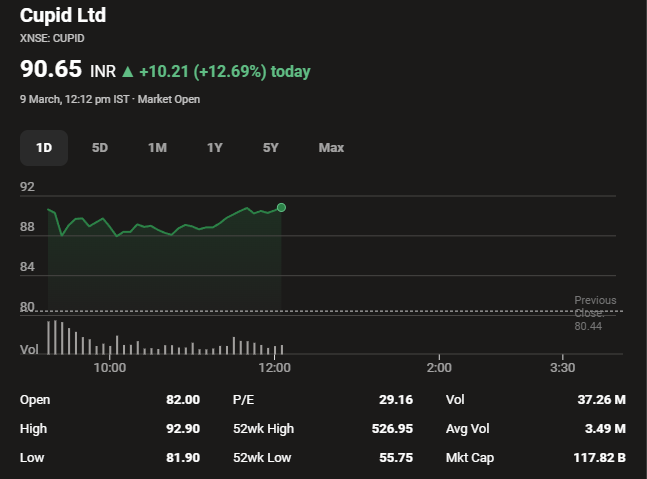
On March 6, 2026, Cupid Limited shares traded between ₹397 and ₹419.4 on the NSE before closing slightly lower at ₹402.20 (down 0.81%). Trading volumes remained strong with over 6.3 million shares exchanged during the session.

  • Market Cap: ₹10,793 – ₹10,942 crore
  • 52-Week Range: ₹55.75 – ₹526.95
  • 1-Year Return: 497% – 503%
  • Year-to-Date Return: -22.52%

Despite the recent correction from its highs, the stock remains a strong performer in the personal care and healthcare sector.

Cupid


4:1 Bonus Issue Details

The biggest catalyst for Cupid stock right now is its 4:1 bonus share issue.
The company has fixed March 9, 2026 as the record date for this corporate action.

This means investors holding Cupid shares by the end of the trading session on March 9 will receive:

  • 4 fully paid-up shares for every 1 share held
  • Face value of each share: ₹1
  • Approximately 10.75 crore new shares to be issued
  • Deemed allotment date: March 10, 2026

Following the bonus issue, the share price will adjust downward proportionally. Analysts estimate the adjusted price could move near ₹80 levels, which may improve liquidity and retail participation.

Financial Highlights

Cupid Limited has delivered strong financial performance in FY26 so far.
The December 2025 quarter (Q3FY26) turned out to be its best quarter ever.

  • Quarterly Revenue: ₹93.50 crore
  • YoY Growth: 101.71%
  • FY26 Revenue Guidance: ₹335 crore
  • Expected PAT: ₹100 crore

Key Financial Ratios:

  • TTM EPS: ₹3.11
  • Price to Earnings (PE): 129.32
  • Sector PE: 52.92
  • Price to Book (P/B): 26.08
  • ROE: 12.9%
  • ROCE: 17.1%
  • Debt to Equity: 0.05 (almost debt free)

The company is also expanding globally and recently received approval to set up an FMCG manufacturing facility in Saudi Arabia, targeted for completion by March 2027.

Recent News & Market Sentiment

Cupid stock has remained highly volatile in recent months. After a 36% correction earlier this year, the stock rebounded nearly 26% in just two days following the Q3 update in January 2026.

On March 5, the stock even touched intraday highs around ₹409, reflecting renewed investor confidence.

However, there are some concerns as well:

  • Foreign institutional investor (FII/FPI) stake declined last quarter
  • High valuation multiples compared to industry peers
  • Possibility of post-bonus correction

Despite this, retail investor sentiment remains extremely bullish, with many community polls showing 100% buy sentiment.

Cupid’s product portfolio includes:

  • Male condoms
  • Female condoms
  • Personal lubricants
  • Healthcare products

Future Outlook for Investors

With the bonus issue becoming effective today, the share price is expected to adjust while liquidity improves significantly in the market.

Key Strengths:

  • Strong revenue and profit growth
  • Expanding global export market
  • New Saudi manufacturing facility
  • Low debt balance sheet

Key Risks:

  • High valuation compared to sector
  • Short-term volatility after bonus issue
  • Dependence on export markets

Many analysts believe Cupid still holds long-term multibagger potential, but investors will closely watch upcoming Q4FY26 results for confirmation of sustained growth momentum.

Disclaimer

This article is for informational and educational purposes only and should not be considered financial or investment advice. Stock market investments are subject to market risks, and past performance does not guarantee future returns. Readers are advised to consult a qualified financial advisor before making
any investment decisions.


Read more

Daylight Saving Time 2026: Clocks Spring Forward Across US & Canada

Daylight Saving Time

“One Hour Forward, A New Debate Begins.”


Table of Contents

DST 2026 Begins: What Happened

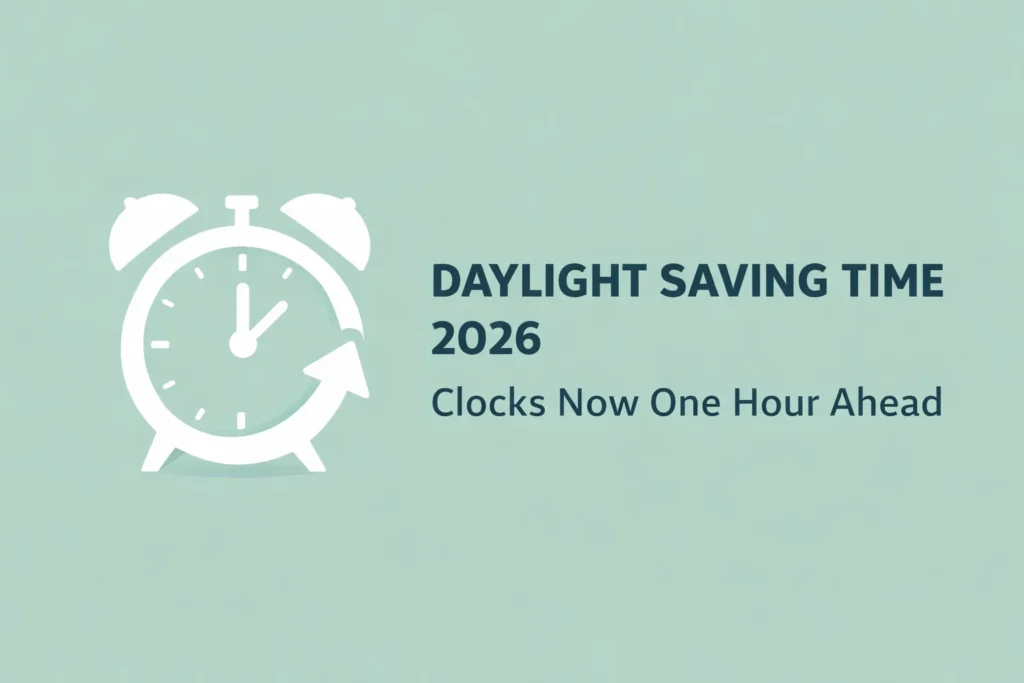
Daylight Saving Time (DST) officially began on March 8, 2026, across most of the United States and Canada. At 2:00 a.m. local time, clocks jumped forward to 3:00 a.m., marking the annual “spring forward” shift.

This time adjustment, governed by the Energy Policy Act of 2005, aims to extend evening daylight hours. While many people welcome brighter evenings, the practice continues to spark debate over its impact on health, productivity, and whether the system should be abolished entirely.

Daylight Saving Time 2026 Schedule

The DST cycle for 2026 follows the traditional schedule used in North America.

Event Date Time Change
DST Begins March 8, 2026 2:00 a.m. → 3:00 a.m.
DST Ends November 1, 2026 2:00 a.m. → 1:00 a.m.

The schedule applies to roughly 40 US states and most Canadian provinces. However, some regions do not observe Daylight Saving Time.

Areas that remain on standard time year-round include:

  • Hawaii
  • Most of Arizona
  • US territories such as Puerto Rico

New Legislative Push to End DST

The debate around Daylight Saving Time has intensified in 2026. Around 15 US states have introduced legislation aiming to eliminate the twice-yearly clock change.

At the federal level, the Sunshine Protection Act—which proposes permanent daylight saving time—remains stalled despite passing the Senate in 2022.

A new proposal called the Daylight Act of 2026, introduced by Representative Greg Steube of Florida, offers a unique compromise.

The proposal suggests:

  • Moving all US time zones forward permanently by 30 minutes
  • Eliminating the need for biannual clock changes
  • Creating a middle-ground between standard time and DST

The bill was referred to the House Energy and Commerce Committee in February 2026 but has not yet progressed further.

Health and Economic Impacts

Health experts frequently warn about the consequences of the spring time shift. Losing an hour of sleep can disrupt the body’s natural circadian rhythm.

Research has linked the time change to:

  • Higher risk of heart attacks and strokes
  • Increased traffic accidents
  • Mood disturbances and fatigue
  • Temporary drops in workplace productivity

From an economic perspective, DST supporters argue it boosts evening activities such as shopping, sports, and outdoor recreation. However, critics point out that it may also increase morning heating and energy costs.

Global Perspective on DST

While the US and Canada switched to daylight saving time on March 8, other regions follow different schedules.

For example, Europe begins DST later on March 29. Several countries worldwide have already abolished the practice, citing limited benefits and health concerns.

With the new US administration in 2026, some analysts believe federal momentum could build again to finally settle the long-running DST debate.

What People Should Do Now

For now, the time change remains in place for 2026. Experts recommend adjusting sleep schedules gradually during the first week after the shift.

Going to bed slightly earlier and limiting late-night screen time can help reduce Monday fatigue and allow the body to adapt to the new daylight schedule.

Until lawmakers decide the future of Daylight Saving Time, millions across North America will continue the yearly routine of springing forward and falling back.


Read more

🏆 India Clinches T20 World Cup 2026 – A Historic Hat-Trick Victory!

T20 World Cup

"Three Crowns, One Champion – India Rules T20 Cricket Again!"

India created cricket history on March 8, 2026, defeating New Zealand by 96 runs in the T20 World Cup 2026 Final at the iconic Narendra Modi Stadium, Ahmedabad. With this victory, India became the first team ever to successfully defend the T20 World Cup title and also the first nation to win three T20 World Cups (2007, 2024, 2026).

📑 Table of Contents

📊 Match Summary

New Zealand captain Mitchell Santner won the toss and chose to field first. The Kiwi side made one change, bringing in Jacob Duffy for Cole McConchie, while India retained their winning semifinal lineup.

India delivered a powerful batting display, posting a huge 255/5 in 20 overs. Despite a brief middle-overs collapse, the Indian lineup maintained aggressive momentum on a batting-friendly surface.

Chasing a mammoth 256-run target, New Zealand struggled under pressure and were eventually bowled out for 159 runs, handing India a comfortable 96-run victory.

🔥 India’s Explosive Batting

India started strongly but experienced a dramatic moment when Sanju Samson, Ishan Kishan, and Suryakumar Yadav fell quickly during a brilliant over from James Neesham. At that stage, India stood at 204/4 after 16 overs.

However, Tilak Varma and Shivam Dube steadied the innings and pushed the total beyond reach. India’s innings also featured a long boundary drought before Hardik Pandya smashed a six after 16 consecutive dot balls.

The team finished with a massive 255/5, one of the highest totals in a T20 World Cup final.

🇳🇿 New Zealand’s Chase Collapse

New Zealand’s chase never truly gained momentum. Arshdeep Singh struck early, conceding just four runs in the opening over while creating pressure immediately.

Although Santner briefly counterattacked with two sixes against Varun Chakaravarthy, the required run rate kept climbing.

By the 15th over, New Zealand were 139/6, needing an improbable finish. India’s disciplined bowling attack ensured the Kiwis were restricted to 159 runs.

🏏 Historic Milestone

This win erased memories of India’s previous heartbreak in Ahmedabad, including the 2023 ODI World Cup final loss. In front of more than 100,000 fans at the world’s largest cricket stadium, India lifted their third T20 World Cup trophy.

The victory also marked back-to-back T20 World Cup titles for India (2024 and 2026), establishing them as the most successful team in the tournament’s history.

Meanwhile, New Zealand’s wait for a T20 World Cup title continues despite another spirited campaign.


Final Result: India beat New Zealand by 96 runs to win the T20 World Cup 2026.


Read more