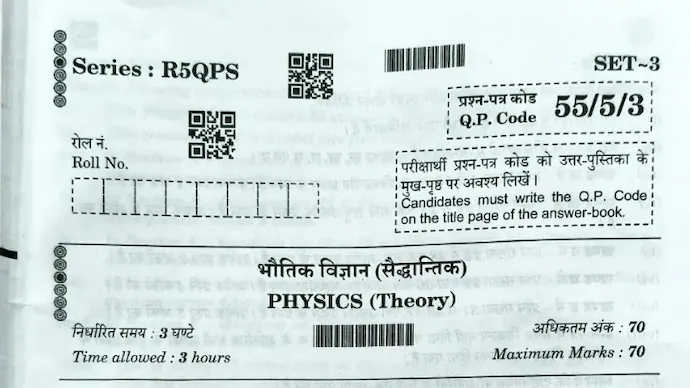
The CBSE Class 12 Physics Board Exam 2026 was conducted on February 20, 2026 from 10:30 AM to 1:30 PM across India. With question papers now circulating online, students and experts have shared mixed reactions — while many students described it as challenging, educators termed it moderate and concept-driven.
The paper strictly followed the latest CBSE blueprint and was divided into five sections:
Section A: 16 MCQs (1 mark each)
Section B: 5 short-answer questions (2 marks each)
Section C: 7 questions (3 marks each)
Section D: 2 case-study based questions (4 marks each)
Section E: 3 long-answer questions (5 marks each)
Internal choices were provided in selected questions, but there was no overall choice. Time management became crucial due to lengthy numerical problems, especially in higher-weightage sections.
Difficulty Level & Student Reactions
Many students found the paper calculation-heavy, particularly:
Multi-step MCQs in Section A
Long numericals in Section E
Conceptual derivations in Section C
However, Section B offered scoring opportunities with direct numericals from:
Ohm’s Law
Ampere’s Law
Lenz’s Law
Case-study questions were application-based, focusing on capacitors and moving charges, testing practical understanding rather than rote memorization.
Expert Analysis: Balanced Yet Conceptual
Education experts described the paper as moderate but concept-focused. The exam covered all major units evenly:
Electrostatics
Current Electricity
Moving Charges and Magnetism
Optics
EMI & AC
NCERT-based derivations and HOTS (Higher Order Thinking Skills) questions were clearly visible. Prepared students found Section E scoring, but lengthy calculations required strong conceptual clarity.
Overall verdict: Conceptual understanding mattered more than memorization.
Key Topics That Dominated the Paper
High-weightage and frequently asked chapters included:
Electric Charges and Fields
Electrostatic Potential and Capacitance
Current Electricity
Moving Charges and Magnetism
Ray Optics and Optical Instruments
The question pattern reflected CBSE’s ongoing shift toward competency-based and real-world problem-solving questions.
No confirmed leaks were reported for Physics, ensuring fair conduct of the examination.
Resources & What Students Should Do Next
Official question papers (Sets 1–4), answer keys, and expert video discussions are now available online for review.
Students are advised to:
Analyze mistakes chapter-wise
Evaluate time management strategy
Strengthen weak numerical concepts
Focus on conceptual clarity for remaining exams
Self-assessment at this stage can significantly improve performance in upcoming board papers.
Final Verdict
The CBSE Class 12 Physics 2026 exam was not impossible — but it demanded preparation, practice, and precision. Students who focused on NCERT concepts and numerical practice likely performed well.
Physics 2026 proved one thing clearly: Concepts win over cramming.