“No danger today—but space rocks never stop coming.”
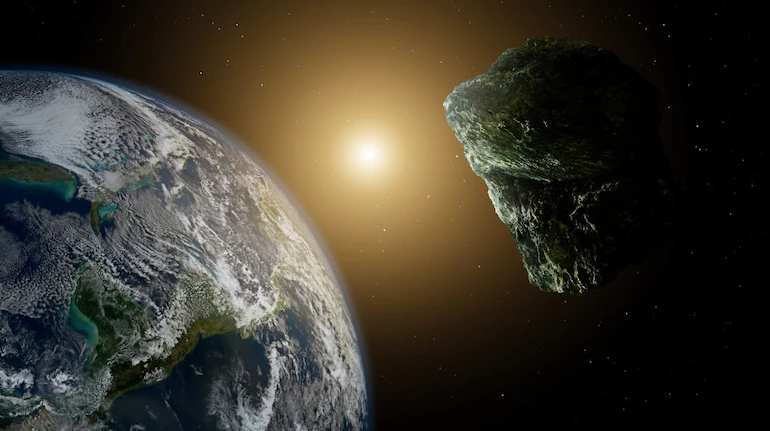
NASA has confirmed that multiple asteroids are making close approaches to Earth this week in January 2026, but officials stress there is no immediate threat. These flybys are being closely tracked as part of ongoing planetary defense efforts, highlighting how much asteroid monitoring has improved in recent years.
🚀 Recent Asteroid Flybys (January 10–12, 2026)
Several small near-Earth objects (NEOs) will pass safely by our planet:
(2026 AB) makes the closest pass on January 10, at about 497,000 miles from Earth—roughly twice the distance to the Moon. It’s estimated to be 35 feet wide, about the size of a bus.
On January 11, (2025 YU6) passes at 986,000 miles. This asteroid is around 72 feet wide, similar in size to a commercial airplane.
Another object, (2025 YL), follows at 1.77 million miles, measuring about 41 feet.
Because of their small size and safe distance, none of these asteroids pose any danger. However, they serve as reminders of why NASA continuously monitors near-Earth space using tools like the Asteroid Watch dashboard.
🌕 What Happened to Asteroid 2024 YR4?
Asteroid 2024 YR4 attracted global attention after briefly reaching a 3.1% chance of Earth impact in December 2024—the highest ever recorded at the time. By February 2025, improved observations from the James Webb Space Telescope allowed scientists to refine its orbit and size (40–90 meters). As a result, the risk dropped to 0.001%, placing it at Torino Scale Level 0—no threat to Earth.
While a very small chance of a lunar impact in 2032 remains, Earth is considered completely safe. Further tracking will resume in 2028.
🛰️ Why This Matters
NASA is preparing to launch the NEO Surveyor telescope in 2026, designed to detect 90% of potentially hazardous asteroids larger than 140 meters. Meanwhile, observatories like the Vera C. Rubin Observatory are already spotting fast-moving objects earlier than ever.
These efforts show how planetary defense has advanced since events like the Chelyabinsk meteor and the successful DART asteroid deflection mission. As of January 10, 2026, there are no elevated risks—only better preparedness.