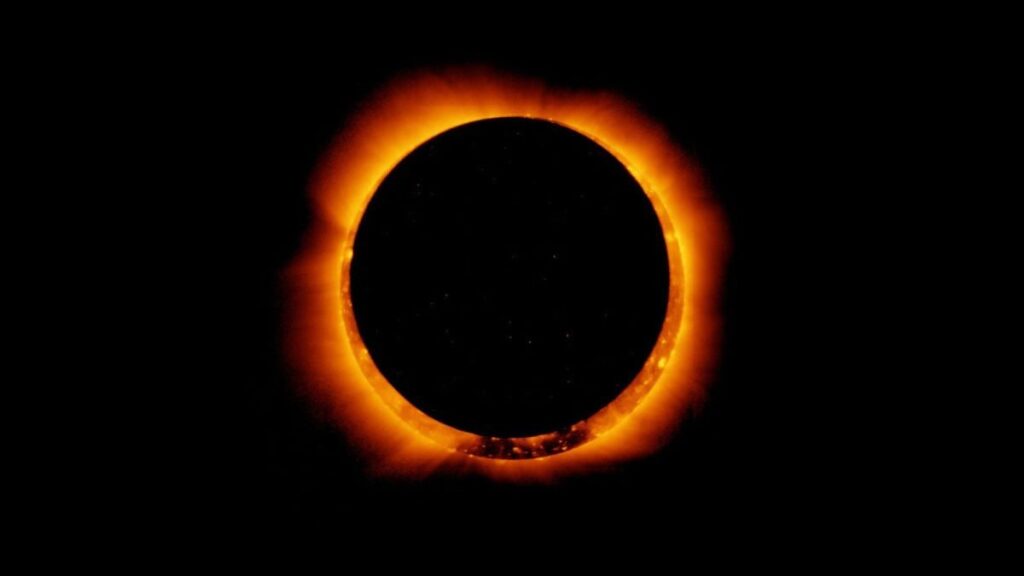
February 17, 2026 will witness the first solar eclipse of the year — a dramatic annular solar eclipse forming a glowing “Ring of Fire” in the skies over Antarctica. While breathtaking, this celestial event will be one of the least witnessed eclipses due to its remote path.
An annular solar eclipse occurs when the Moon passes between Earth and the Sun but appears slightly smaller in the sky. Instead of fully blocking the Sun, it leaves a bright outer ring — famously called the “Ring of Fire.”
📊 Eclipse Details & Magnitude
Date: February 17, 2026
Peak Magnitude: 0.963
Maximum Annularity Duration: 2 minutes 5 seconds
Best Viewing Point: Near Concordia Station, Antarctica
Moon Position: 6.8 days after apogee (appears smaller)
The annular phase begins around 19:46 local time near Concordia Station and ends shortly after.
🌍 Visibility Path & Regions
The full annular phase is visible only across Antarctica, with no major populated areas in its narrow path — making it one of the least observed eclipses in recent years.
🌎 Partial Visibility Regions:
Chile (Punta Arenas) – Up to 1.81%
South Africa (Cape Town) – 5.19%
Durban – Up to 16.10%
Madagascar (Antananarivo) – 19.98%
Marion Island – 47.62%
Bouvet Island – 16.92%
Southern tips of Argentina and Mozambique
⏰ Global Timing Overview (UTC)
Partial Eclipse Begins: 06:59 UTC (near Marambio Base, Antarctica)
Partial Eclipse Ends: 20:55 UTC (near Casey Station)
Cape Town: 14:01 – 15:24 local time
🇮🇳 Will It Be Visible From India?
No. The February 17, 2026 annular solar eclipse will not be visible from India due to its southern polar path.
🛑 Safe Viewing Tips
If viewing partial phases from southern Africa:
Use certified solar eclipse glasses
Never look directly at the Sun without protection
Use solar filters for telescopes and cameras
Watch live streams from Antarctic observatories for the annular phase
Direct Sun gazing can cause permanent eye damage.
🔬 Scientific Importance
This eclipse occurs near the Moon’s ascending node, highlighting precise orbital alignments. Researchers stationed at Antarctic facilities like Concordia will observe solar corona features during the brief ring phase.
Interestingly, this event precedes another major celestial highlight — a total solar eclipse on August 12, 2026 — making 2026 an exciting year for skywatchers.
✨ Final Takeaway
The February 17, 2026 annular solar eclipse may be remote, but it reminds us how perfectly aligned cosmic mechanics create rare and breathtaking moments. Even if you can’t see it in person, live streams will bring the Antarctic Ring of Fire to screens worldwide.
Stay tuned for more space updates and astronomical events of 2026!