
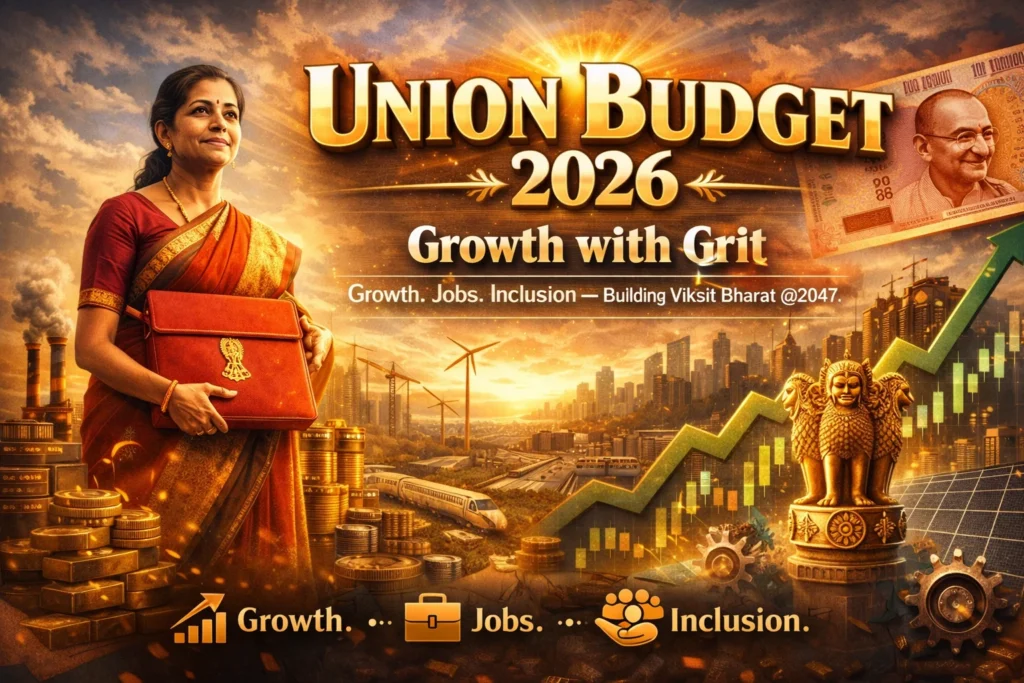
“Growth. Jobs. Inclusion — Building Viksit Bharat @2047.”
Table of Contents
- Budget 2026-27: Big Picture
- Fiscal Targets & Numbers
- Manufacturing & MSME Push
- Infrastructure & Energy Drive
- Skills, Services & Youth Focus
- Agriculture & Inclusive Growth
- Tax Reliefs & Policy Reforms
- Why This Budget Matters
Budget 2026-27: Big Picture
Presented on February 1, 2026, India’s Union Budget 2026-27 lays out a roadmap to sustain
7% economic growth amid global uncertainty. Finance Minister Nirmala Sitharaman
anchors the budget around three national “kartavya” — accelerating growth, empowering aspirations through
skills, and ensuring inclusive development under the vision of
“Sabka Sath, Sabka Vikas.”
Fiscal Targets & Key Numbers
The government stays firm on fiscal discipline while scaling investment:
- Capital Expenditure: ₹12.2 lakh crore (up from ₹11.2 lakh crore)
- Fiscal Deficit: 4.3% of GDP (reduced from 4.4%)
- Debt-to-GDP: 55.6%
- Net Tax Receipts: ₹28.7 lakh crore
- Total Expenditure: ₹53.5 lakh crore
Major infrastructure announcements include seven high-speed rail corridors
(Mumbai–Pune, Delhi–Varanasi and more) and a new
Dankuni–Surat freight corridor.
Manufacturing & MSME Push
The budget gives a strong atmanirbharta boost to strategic manufacturing:
- Biopharma SHAKTI: ₹10,000 crore for biologics & innovation
- ISM 2.0: Semiconductor manufacturing expansion
- Electronics PLI: ₹40,000 crore allocation
- Rare Earth Corridors: Odisha & Kerala
- Chemical Parks: Three parks per state
For MSMEs, the government announces a ₹10,000 crore equity fund,
TReDS platform upgrades, and “Corporate Mitras” to simplify compliance.
Infrastructure & Energy Drive
Infrastructure remains the backbone of growth:
- 20 new National Waterways
- Coastal cargo scheme to raise inland shipping share to 12% by 2047
- Seaplane operations incentives
- ₹20,000 crore for CCUS in steel and cement
City Economic Regions receive ₹5,000 crore each over five years, while the
Purvodaya Plan accelerates eastern India’s industrial corridor.
Skills, Services & Youth Focus
A youth-centric approach dominates the services and skills agenda:
- High-powered committee for services sector expansion
- Training of 1 lakh allied health professionals
- 1.5 lakh caregivers to be skilled
- Five medical tourism hubs
- AVGC labs in schools & Khelo India Mission push
Special initiatives include SHE-Marts for women entrepreneurs,
Divyangjan skill programs, and NIMHANS-2 for mental healthcare.
Agriculture & Inclusive Growth
The rural and agri economy sees tech-driven inclusion:
- Bharat-VISTAAR AI for farmers
- Coconut, cashew & cocoa value-chain programs
- Fisheries development in 500 reservoirs
- New veterinary colleges
- Buddhist tourism circuits in the Northeast
Under the 16th Finance Commission, states receive grants worth
₹1.4 lakh crore.
Tax Reliefs & Policy Reforms
Tax compliance gets simpler and lighter:
- New Income Tax Act 2025 effective April 1
- TCS cut to 2% on education & foreign tours
- Simplified TDS rules
- Return filing deadline extended to March 31
- One-time foreign asset disclosure for small taxpayers
Additional relief includes exemptions for cancer drugs,
EV batteries, and rationalized penalties.
Why This Budget Matters
Union Budget 2026-27 strikes a balance between growth and discipline. With a sharp
focus on manufacturing, infrastructure, youth skills, and tax simplification, it
positions India firmly on the path to Viksit Bharat by 2047.
A reform-driven, youth-powered budget designed to
deliver jobs, resilience, and long-term prosperity.