
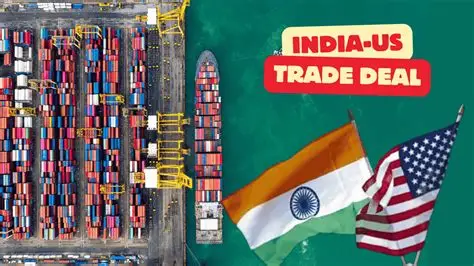
India-US Trade Deal Breakthrough: Tariffs Slashed, Trade Boosted

India-US Trade

“Lower Tariffs, Stronger Ties, Bigger Trade Future”


Table of Contents

Deal Announcement

The India-US trade relationship hit a major milestone as US President Donald Trump announced a new trade agreement on February 1–2, 2026.
The pact reduces reciprocal tariffs on Indian exports from 25% to 18%, marking a significant relief for Indian businesses.

President Trump revealed the breakthrough on Truth Social, crediting his personal rapport with Prime Minister Narendra Modi for accelerating negotiations.
Both leaders described the agreement as a key step toward achieving $500 billion in bilateral trade by 2030.

Tariff Reductions Explained

Before the agreement, Indian goods faced steep 50% US tariffs imposed in August 2025—25% reciprocal duties plus 25% punitive tariffs linked to India’s Russian oil imports.

Under the new deal:

  • Tariffs on Indian exports drop sharply to 18%
  • Major relief for sectors like textiles, chemicals, seafood, and engineering goods
  • India commits to gradually reducing Russian oil purchases
  • Increased imports of US energy, technology, agriculture, and coal

Negotiation Background

Negotiations gained momentum after President Trump’s re-election in 2025. Multiple rounds of talks in Washington and New Delhi laid the foundation for a comprehensive Bilateral Trade Agreement (BTA).

Commerce Minister Piyush Goyal stated in January 2026 that no major obstacles remained. The Economic Survey 2026 also projected an imminent closure, backed by high-level diplomatic visits from both sides.

Economic & Strategic Impact

Experts believe the agreement will:

  • Strengthen global supply chains
  • Lower costs for exporters, businesses, and consumers
  • Boost investments in energy, technology, and manufacturing
  • Deepen strategic cooperation amid global economic uncertainty

India emerges as an early beneficiary of Trump’s renewed trade strategy, avoiding broader tariffs imposed on other partners.

What This Means Going Forward

Officials from both nations emphasize that the deal is mutually beneficial, without compromising sensitive areas like farm subsidies.
With tariffs reduced and market access widened, the agreement sets the stage for a stronger, more balanced India-US economic partnership in the coming decade.

This trade deal signals a new phase of cooperation—where diplomacy meets economic opportunity.
 

Read more

Trump’s Bold Moves: Iran, Venezuela, Greenland & U.S. Power Play in 2026

Trump

“Global Tension Rising — How Trump’s Next Moves Could Reshape the World.”


U.S. President Donald Trump is taking strong action on multiple global fronts in early 2026, with rising tensions in Iran, dramatic moves in Venezuela, renewed interest in Greenland, and major shifts at home that are shaping world politics.
In Iran, nationwide protests against economic hardship and government rule have drawn global attention. The unrest — part of the 2025-26 uprising — has spread across dozens of cities and led to a violent crackdown, with rights groups reporting more than 500 deaths and thousands arrested as authorities try to suppress the movement. Iran’s government has cut off most internet access to control information and has warned that foreign interference would trigger retaliation. In response, President Trump has said the U.S. military is examining “very strong options,” including military, cyber, or economic actions, and even exploring restoring internet access via Elon Musk’s Starlink network to assist protesters. Iran has called these comments interference in its internal affairs, while global leaders watch anxiously to avoid further escalation.
Meanwhile, in Venezuela, the Trump administration carried out a significant operation that resulted in the capture and transfer of President Nicolás Maduro to the U.S. for trial on criminal charges, according to recent reports. Trump has moved to protect Venezuelan oil revenue and is engaging with opposition leaders to shape the country’s future. The bold action has sparked global debate on sovereignty, security, and U.S. influence in Latin America.
Trump has also renewed his controversial interest in Greenland, a vast Arctic territory of Denmark. Calling Greenland strategically important for national security, he has suggested the U.S. might pursue control — even by force if necessary — a stance strongly rejected by Danish and Greenlandic leaders who insist on their sovereignty.
At home, Trump’s administration continues sweeping changes by firing federal workers, freezing new hires, adjusting civil service rules, exiting international organizations it sees as harmful, and imposing tariffs on major trade partners to boost U.S. manufacturing. These domestic reforms — alongside assertive foreign policy — are shaping the first year of his second term in a dramatic way.
World leaders, rights observers, and markets are paying close attention as these tensions unfold — and the next moves could define international relations for years.

Read more