
“From Orbit to Earth — India Shines Brighter Than Ever.”
Table of Contents
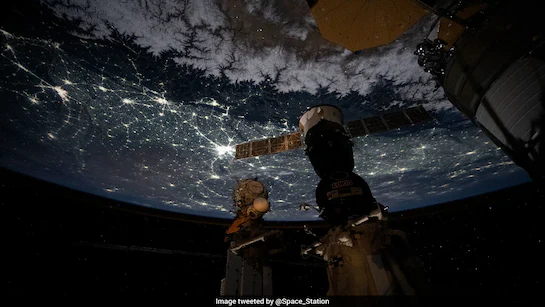
ISS Captures Breathtaking Night View of India
India’s rapidly advancing space ecosystem has once again captured global attention.
On March 10–11, 2026, astronauts aboard the International Space Station (ISS)
photographed a stunning nighttime view of the Indian subcontinent from an altitude of around
400 kilometers above Earth.
The mesmerizing image shows a glowing network of city lights stretching across the country.
Major urban clusters appear like golden constellations on Earth, reflecting India’s dense population,
infrastructure expansion, and economic activity. The ISS shared the image through its official
social media channels, where it quickly went viral among space enthusiasts and scientists alike.
The photograph was taken as the ISS traveled from the Arabian Sea toward the Himalayan region.
The contrast between illuminated cities and the dark surrounding landscapes created a dramatic
visual representation of India’s nighttime vibrancy.
This is not the first time India has been highlighted from orbit. Earlier images captured in
2025 by Indian-origin astronaut Shubhanshu Shukla also showcased the
country’s glowing nightscape, reinforcing global fascination with India from space.
NISAR Satellite Begins High-Resolution Earth Scans
Another major milestone in space observation came with the
NASA-ISRO Synthetic Aperture Radar (NISAR) satellite, launched on
July 30, 2025. By late November 2025, the satellite began its scientific operations
and released the first high-resolution radar images of Earth, including detailed observations of India.
One of the most notable early captures was the Godavari River Delta in Andhra Pradesh.
The satellite’s advanced radar system is capable of identifying features as small as
5–15 meters.
NISAR uses two powerful radar systems:
- L-band radar developed by NASA
- S-band radar developed by ISRO
These radars can penetrate clouds and operate both day and night, making them extremely valuable
for monitoring Earth’s surface. Orbiting at approximately 747 km above Earth,
the satellite scans land and ice surfaces every 12 days.
This capability allows scientists to monitor:
- Natural disasters
- Agricultural changes
- Forest and mangrove ecosystems
- River movement and flooding patterns
- Climate change indicators
The mission represents one of the largest collaborations between NASA and ISRO,
pushing the boundaries of Earth observation technology.
Recent ISRO Satellite Imaging Developments
India’s own satellites are also producing impressive Earth imagery.
The INSAT-3DS meteorological satellite, activated in early 2025,
began sending high-quality atmospheric and Earth surface images using advanced instruments:
- 6-channel Imager
- 19-channel Sounder
These sensors allow scientists to monitor:
- Rainfall patterns
- Vegetation health
- Fog formation
- Atmospheric moisture
- Ozone distribution
Meanwhile, in January 2026, India launched the
PSLV-C62 mission carrying DRDO’s hyperspectral satellite
EOS-N1 “Anvesha”. This satellite was designed to analyze Earth using
hundreds of spectral bands, enabling detection of material compositions on the surface.
Such hyperspectral imaging can help identify:
- Crop stress and plant diseases
- Mineral deposits
- Environmental changes
- Defense surveillance applications
Although the mission experienced orbit-related issues, it demonstrated India’s growing
capabilities in advanced space observation technologies.
Why These Images Matter for India
Satellite imagery plays a critical role in modern governance and scientific research.
India’s expanding satellite network supports multiple sectors including:
- Disaster management and flood monitoring
- Agriculture planning and crop forecasting
- Urban development tracking
- Climate research
- Environmental conservation
With international collaborations and advanced indigenous missions,
India is steadily strengthening its position as a global leader in
space imaging and Earth observation technology.