
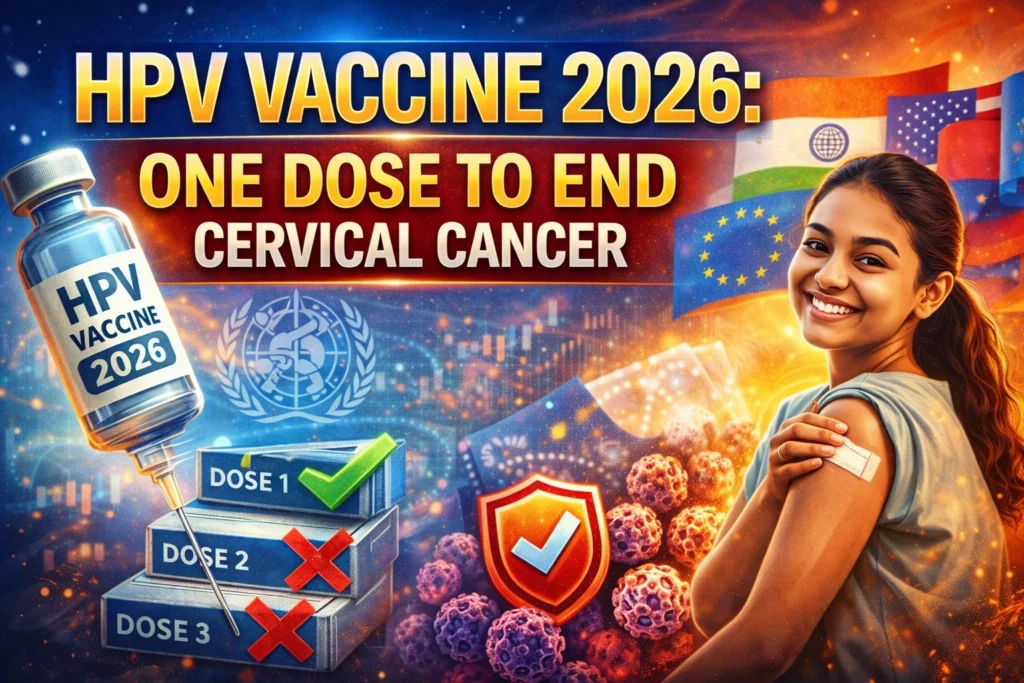
“One Dose Today, A Cancer-Free Tomorrow.”
Major HPV vaccination updates in 2026 are transforming global cervical cancer prevention strategies. From simplified single-dose regimens to nationwide immunization drives, health authorities worldwide are accelerating efforts to eliminate one of the deadliest yet preventable cancers.
📑 Table of Contents
- U.S. Schedule Shift to Single Dose
- WHO Single-Dose Approval & Global Funding
- Proven Long-Term Effectiveness
- India’s Nationwide HPV Vaccination Launch
- Europe Expands Access
- Updated Global Recommendations
- The Road Ahead
🇺🇸 U.S. Schedule Shift to Single Dose
On January 5, 2026, the CDC revised its childhood vaccine schedule, recommending a single HPV vaccine dose for children aged 11–12, replacing the earlier 2–3 dose protocol.
This decision follows 20-year research from Costa Rica demonstrating that one dose provides protection comparable to two doses against HPV16 and HPV18 — strains responsible for 70% of cervical cancers.
The update aims to improve vaccination rates, which dropped from 63% in 2022 to 57.3% in 2023. While coverage for the first dose remains secure, insurers may limit coverage for additional doses after 2026.
🌍 WHO Single-Dose Approval & Global Funding Boost
In October 2024, WHO prequalified Cecolin® for single-dose use, addressing global supply shortages and strengthening efforts to vaccinate 90% of girls by age 15.
This builds upon WHO’s 2022 guidelines endorsing simplified schedules. Additionally, new funding of US$600 million from partners including Gavi and the Gates Foundation is accelerating vaccine access in low-income nations.
The strategy supports WHO’s long-term goal of eliminating cervical cancer as a public health threat worldwide.
📊 Proven Long-Term Effectiveness
Long-term real-world data confirms the vaccine’s powerful impact:
- Sweden: 87% reduction in invasive cervical cancers and 97% reduction in precancers among vaccinated young women.
- Denmark: Less than 1% prevalence of high-risk HPV types in vaccinated groups, showing strong herd immunity.
When administered before HPV exposure, vaccine efficacy approaches nearly 100% against targeted HPV strains.
🇮🇳 India’s Nationwide HPV Vaccination Launch
On February 24, 2026, India announced a free nationwide HPV vaccination drive under its national immunization program.
The campaign targets one crore 14-year-old girls with voluntary Gardasil vaccination, addressing cervical cancer — one of the leading causes of cancer-related deaths among Indian women.
This marks a major step forward in expanding preventive healthcare access across the country.
🇪🇺 Europe Expands Coverage
France expanded reimbursement for Gardasil 9 in December 2025, covering all men and women up to age 26.
The program prioritizes ages 11–14 with catch-up vaccination options, aiming to reduce gender disparities and ensure broader community protection.
🩺 Updated Global Recommendations
Leading medical bodies now recommend:
- Routine vaccination at ages 11–12
- Catch-up vaccination through age 26
- Shared decision-making for adults up to age 45
- Self-collected HPV screening in areas with infrastructure support
By November 2025, 158 countries had integrated HPV vaccines into national immunization programs, reaching 86 million girls through Gavi-supported initiatives.
🚀 The Road Ahead
The global shift toward simplified single-dose HPV vaccination marks a turning point in public health. With improved access, expanded funding, and proven long-term effectiveness, the world is moving closer to eliminating cervical cancer.
Challenges remain — particularly closing coverage gaps — but momentum is clearly building toward a future where cervical cancer becomes a preventable disease of the past.
One dose could change millions of lives.