

Volatility Returns. Support Tested. Monday Decides the Mood.
📌 Table of Contents
Closing Performance Snapshot
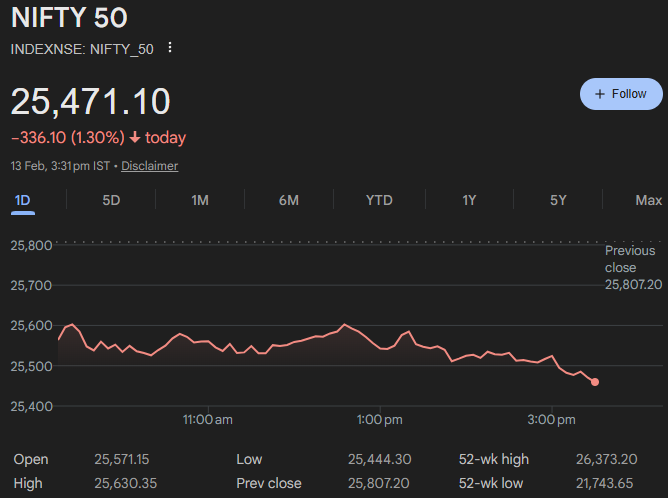
The NIFTY 50 index closed sharply lower on Friday, February 13, 2026, dragged down by heavy selling in IT and metal stocks.
- Closing Level: 25,471.10
- Loss: 336.10 points (-1.30%)
- Day’s Low: 25,444.30
- Opening: 25,571.15
This marked the second consecutive session of decline, with the index slipping below the crucial 25,500 level. Meanwhile, the Sensex tanked over 1,000 points, reflecting broad market weakness.
Volatility spiked significantly as India VIX surged 13.36% to 13.29, indicating rising fear among traders.
However, GIFT NIFTY futures suggest a mildly positive start on Monday, February 16, trading near 25,520 (+0.26%).
Key Sector Moves
- NIFTY IT: Fell 1.44% to 32,681.50 amid AI concerns and weak global tech cues.
- Metals: Plunged 3.31% to 11,872.80 due to soft global commodity prices.
- FMCG: Dropped 1.90%.
- Bank Nifty: Declined 0.91% to 60,186.65, outperforming broader markets supported by private banks.
Broader markets underperformed further:
- NIFTY Midcap 100: Down 1.71%
- Smallcaps also witnessed sharp selling pressure.
Top Gainers & Losers
Major Drags:
- HUL – Down 4%
- Eternal – Down 4%
- TechM – Down 6%
- HCL Tech – Down 5%
Relatively Better Performer:
- Bajaj Finance contributed positively during the session but ended lower at ₹1,024.75.
The weakness remained broad-based with limited defensive support.
Technical Outlook & Key Levels
From a technical perspective, the market now stands at a crucial junction.
- Immediate Resistance: 25,630 (prior swing high)
- Immediate Support: 25,444
- Major Psychological Support: 25,000
A decisive break below Friday’s low could push the index toward the 200-DMA zone.
Experts suggest:
- Avoid aggressive shorting in IT at current levels.
- Look for dip-buying opportunities in banks, auto, and chemical stocks.
Meanwhile, the rupee weakened to 90.64/USD, adding pressure on sentiment.
Global Market Cues
Global signals remained mixed:
- Nikkei: -1.21%
- Hang Seng: -1.72%
- US Futures: Flat
- Dow: +0.01%
- Nasdaq: -0.24%
Ongoing profit-booking and foreign institutional flows will play a decisive role in the upcoming sessions.
What to Watch on Monday
- Opening trend based on GIFT NIFTY
- Movement in IT heavyweights
- FII & DII activity
- Volatility index direction
- Breakdown or recovery above 25,500
The market has entered a high-volatility zone. Monday’s opening reaction could determine whether this is a short-term correction or the beginning of a deeper pullback.
Disclaimer: This article is for informational purposes only and not investment advice. Investors should consult financial advisors before making trading decisions.