
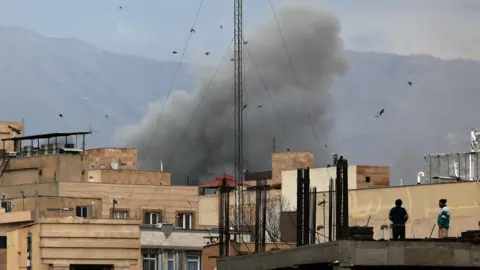
“Middle East on Edge – Missiles Fly, Alliances Activate, and the World Watches.”
The Iran–Israel conflict has dramatically escalated in March 2026, with intense airstrikes, missile launches, and expanding regional involvement.
Israel’s latest operations targeted key Iranian military and political infrastructure, while Iran responded with massive missile and drone barrages toward Israeli cities.
As the conflict widens, international involvement and regional tensions are pushing the Middle East toward one of its most dangerous crises in years.
Table of Contents
- Israel’s Escalating Airstrikes on Iran
- Major Israeli–US Coordinated Strikes
- Iran’s Missile Retaliation
- Regional Expansion of the Conflict
- US Political Support and Global Reaction
- What Could Happen Next?
Israel’s Escalating Airstrikes on Iran
By March 5, 2026, Israel launched its 11th wave of airstrikes targeting Tehran. These operations focused on destroying
Iran’s military command centers, missile launch systems, and compounds belonging to the Islamic Revolutionary Guard Corps (IRGC).
In a rare aerial encounter, new combat footage reportedly shows an Israeli F-35I fighter jet shooting down an Iranian aircraft.
The Israeli Defense Forces (IDF) also claim their strikes have destroyed nearly 30% of Iran’s missile launch infrastructure and several
military supply convoys.
Major Israeli–US Coordinated Strikes
The conflict intensified further with joint Israeli-US operations hitting more than 500 strategic targets across Iran.
These strikes reportedly included locations tied to Iran’s political and military leadership.
Key areas targeted included:
- Pasteur Street district in Tehran, near the residence of Supreme Leader Ali Khamenei
- Iran’s Presidential Palace and National Security Council facilities
- Supreme National Security Council headquarters
- Expediency Discernment Council complex
- An alleged underground nuclear facility known as Min Zadai
- Bushehr Airport terminal and an Iran Air aircraft
Unfortunately, collateral damage was also reported. Civilian infrastructure such as schools, hospitals, Tehran’s Grand Bazaar, and Golestan Palace
suffered damage during the strikes.
Iran’s Missile Retaliation
Iran responded with one of its largest missile offensives in recent years.
Hundreds of ballistic missiles and armed drones were launched toward Israel.
According to Israeli authorities:
- At least 11 civilians were killed in missile attacks.
- More than 100 people were injured.
- Major cities including Tel Aviv, Haifa, Holon, Ramat Gan, and Rishon LeZion were targeted.
The strikes damaged residential areas and reportedly hit facilities including the Soroka Medical Center.
Fires also broke out near the BAZAN oil refinery in Haifa.
Israel’s missile defense systems intercepted the majority of the projectiles, with officials estimating that
only about 20 missiles struck urban zones out of nearly 400 launched.
Iran also claimed to have downed several Israeli drones and deployed advanced Sejjil ballistic missiles.
Regional Expansion of the Conflict
The conflict is no longer limited to Iran and Israel.
The Lebanese militant group Hezbollah joined the confrontation by launching missile barrages toward northern Israel.
In response, Israel carried out airstrikes on Beirut suburbs and expanded military operations in southern Lebanon.
Other regional developments include:
- Gulf states assisting Israel in intercepting incoming missiles
- Iran targeting US military bases in the region
- Allegations of cluster bomb use in some strikes
- Evacuation orders issued in Tehran amid growing security concerns
US Political Support and Global Reaction
Political developments in Washington have also played a crucial role.
The US Senate recently blocked attempts to limit anti-Iran military operations, effectively backing
President Donald Trump’s strategy in the region.
Officials confirmed that several of the airstrikes on Iranian targets were coordinated between US and Israeli forces.
Despite brief diplomatic attempts, no stable ceasefire has been reached.
As of March 6–7, 2026, both sides continue exchanging strikes, with Israel targeting radar installations near Tehran after a short-lived truce collapsed.
What Could Happen Next?
Military analysts warn that the ongoing confrontation could escalate into a broader regional war if more countries become directly involved.
With continued missile exchanges, airstrikes, and growing geopolitical pressure, the situation remains extremely volatile.
The coming days will likely determine whether diplomacy can slow the escalation or whether the conflict expands further across the Middle East.
As of early March 2026, missile launches and retaliatory strikes are still ongoing, and international leaders are urging both sides to avoid a full-scale regional war.