
FY 2026-27 Begins: Big Policy Shifts, Same Tax Slabs

2026-27

New Financial Year, New Opportunities – Plan Smart, Grow Faster!

📌 Table of Contents


📊 Overview

India’s financial year 2026-27 has officially begun from April 1, 2026, bringing key updates in tax rules, investments, and regulations.
The Union Budget focuses on youth-driven growth and infrastructure expansion, while keeping the basic income-tax structure largely unchanged.

🚀 Budget & Growth Focus

  • Capital expenditure increased to ₹12.2 lakh crore.
  • Strong push for electronics, renewable energy, biopharma.
  • Focus on rare-earth corridors to reduce imports.
  • Agriculture boost via fisheries, high-value crops, and AI advisory.

💰 Tax & Income Changes

A major shift comes with the introduction of the Income Tax Act 2025, replacing older laws.
While tax slabs remain mostly unchanged, compliance becomes simpler with updated forms and rules.

  • New ITR forms for AY 2026-27.
  • Changes in TDS/TCS rates and deadlines.
  • Simplified procedures for taxpayers and businesses.

📈 Investment & Savings Updates

  • SGB tax benefits now mainly for original investors.
  • Higher STT on F&O, increasing trading costs.
  • Fresh limits under Section 80C reset for new planning.

This creates a new opportunity window for investing in PPF, ELSS, NPS, and insurance from the start of the year.

⚙️ Regulatory Changes

  • Stricter norms on digital payments and fraud prevention.
  • Increased data security compliance for fintech and banks.
  • FASTag corporate fee slightly raised to ₹3,075.

🔮 Outlook

FY 2026-27 signals a balanced approach—strong infrastructure push, stable taxes, and tighter regulations.
Investors and taxpayers should focus on early planning, compliance, and sectoral opportunities to maximize gains this year.


Read more

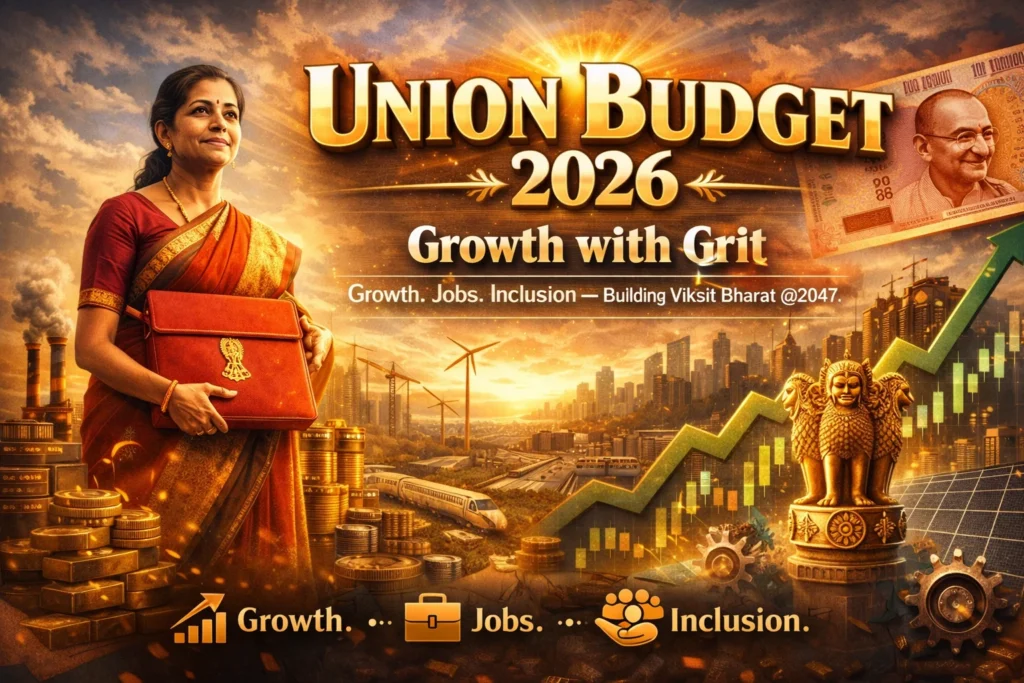
Union Budget 2026: Growth with Grit

Union Budget

“Growth. Jobs. Inclusion — Building Viksit Bharat @2047.”

Table of Contents

Budget 2026-27: Big Picture

Presented on February 1, 2026, India’s Union Budget 2026-27 lays out a roadmap to sustain
7% economic growth amid global uncertainty. Finance Minister Nirmala Sitharaman
anchors the budget around three national “kartavya” — accelerating growth, empowering aspirations through
skills, and ensuring inclusive development under the vision of
“Sabka Sath, Sabka Vikas.”

Fiscal Targets & Key Numbers

The government stays firm on fiscal discipline while scaling investment:

  • Capital Expenditure: ₹12.2 lakh crore (up from ₹11.2 lakh crore)
  • Fiscal Deficit: 4.3% of GDP (reduced from 4.4%)
  • Debt-to-GDP: 55.6%
  • Net Tax Receipts: ₹28.7 lakh crore
  • Total Expenditure: ₹53.5 lakh crore

Major infrastructure announcements include seven high-speed rail corridors
(Mumbai–Pune, Delhi–Varanasi and more) and a new
Dankuni–Surat freight corridor.

Manufacturing & MSME Push

The budget gives a strong atmanirbharta boost to strategic manufacturing:

  • Biopharma SHAKTI: ₹10,000 crore for biologics & innovation
  • ISM 2.0: Semiconductor manufacturing expansion
  • Electronics PLI: ₹40,000 crore allocation
  • Rare Earth Corridors: Odisha & Kerala
  • Chemical Parks: Three parks per state

For MSMEs, the government announces a ₹10,000 crore equity fund,
TReDS platform upgrades, and “Corporate Mitras” to simplify compliance.

Infrastructure & Energy Drive

Infrastructure remains the backbone of growth:

  • 20 new National Waterways
  • Coastal cargo scheme to raise inland shipping share to 12% by 2047
  • Seaplane operations incentives
  • ₹20,000 crore for CCUS in steel and cement

City Economic Regions receive ₹5,000 crore each over five years, while the
Purvodaya Plan accelerates eastern India’s industrial corridor.

Skills, Services & Youth Focus

A youth-centric approach dominates the services and skills agenda:

  • High-powered committee for services sector expansion
  • Training of 1 lakh allied health professionals
  • 1.5 lakh caregivers to be skilled
  • Five medical tourism hubs
  • AVGC labs in schools & Khelo India Mission push

Special initiatives include SHE-Marts for women entrepreneurs,
Divyangjan skill programs, and NIMHANS-2 for mental healthcare.

Agriculture & Inclusive Growth

The rural and agri economy sees tech-driven inclusion:

  • Bharat-VISTAAR AI for farmers
  • Coconut, cashew & cocoa value-chain programs
  • Fisheries development in 500 reservoirs
  • New veterinary colleges
  • Buddhist tourism circuits in the Northeast

Under the 16th Finance Commission, states receive grants worth
₹1.4 lakh crore.

Tax Reliefs & Policy Reforms

Tax compliance gets simpler and lighter:

  • New Income Tax Act 2025 effective April 1
  • TCS cut to 2% on education & foreign tours
  • Simplified TDS rules
  • Return filing deadline extended to March 31
  • One-time foreign asset disclosure for small taxpayers

Additional relief includes exemptions for cancer drugs,
EV batteries, and rationalized penalties.

Why This Budget Matters

Union Budget 2026-27 strikes a balance between growth and discipline. With a sharp
focus on manufacturing, infrastructure, youth skills, and tax simplification, it
positions India firmly on the path to Viksit Bharat by 2047.

A reform-driven, youth-powered budget designed to
deliver jobs, resilience, and long-term prosperity.


Read more