Sensex Soars 2.6% – Markets Bounce Back with Massive Rally

Markets

Big Bull Run Returns: ₹13 Lakh Crore Wealth Created in Hours!

📌 Table of Contents


📊 Opening Performance

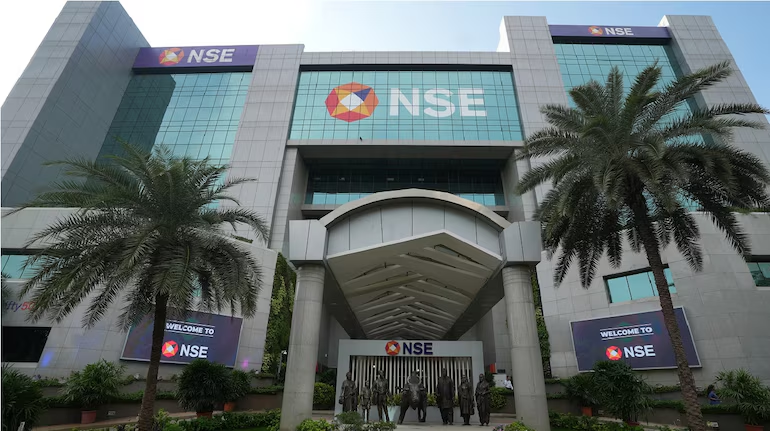
Indian stock markets kicked off April 1, 2026, with a powerful rally after a weak FY26 close.
The BSE Sensex surged over 1,900 points (2.66%) to 73,859 by early trading, rebounding from Monday’s close of 71,947.
Similarly, the NSE Nifty 50 jumped 2% to 22,912, reflecting strong bullish sentiment across sectors.

🚀 Key Drivers

  • Improved global sentiment after signals of possible de-escalation in US-Iran tensions.
  • Strong opening cues from GIFT Nifty, indicating a gap-up start.
  • Massive wealth creation of ₹13 lakh crore within the first hour.
  • Continued support from Domestic Institutional Investors (DIIs) despite FII selling.

📈 Top Gainers & Losers

  • Trent: +6.70% (₹3,516)
  • BEL: +6.13% (₹425)
  • Shriram Finance: +5% (₹919)
  • Adani Ports: +5.13% (₹1,380)
  • Bajaj Finance: +4.72% (₹839)

Broad-based buying was seen across sectors, with defence and financial stocks leading the rally.

📉 FY26 Context

Despite today’s surge, markets closed FY26 in the red.
The Sensex declined around 7% (5,467 points), while Nifty dropped 5% (1,200 points),
due to global uncertainties and domestic pressures.
India VIX rose to 27.89, indicating higher volatility, while market valuations remained around a P/E of 19.8–20.2.

🔮 Outlook & Key Levels

Analysts expect short-term bullish momentum to continue, with key levels to watch:

  • Nifty Support: 22,400 | Resistance: 23,200
  • Sensex Support: Around 73,000

Upcoming market holidays on April 3 (Good Friday) and April 14 (Ambedkar Jayanti) may impact trading volumes.
Investors are also tracking key stocks like IndiGo, Bharti Airtel, and GRSE for further cues.
Read more

Stock Market Closed Today – NSE & BSE Shut for Mahavir Jayanti

Stock Market

Pause Before the Pulse: Markets Take a Break Today!

📌 Table of Contents


📊 Market Status Today

Indian stock markets remain closed on March 31, 2026 on account of Mahavir Jayanti.
Both the NSE and BSE have suspended trading across all segments, including equity, derivatives, currency, and commodities.

Trading will resume on April 1, 2026, although it may coincide with a settlement holiday due to annual bank closing.

⛏️ Commodity Market Timings

  • MCX: Closed from 9:00 AM to 5:00 PM, open in evening session (5:00 PM – 11:55 PM).
  • NCDEX: Fully closed for the entire day.

This allows limited trading activity in non-agricultural commodities during evening hours.

📉 Recent Market Context

Markets recently witnessed a sharp decline, with Nifty 50 falling 2.14% to 22,331.40 and
Sensex dropping 2.22% to 71,947.55 in the previous session.

  • Banking Sector: Down 3.82%
  • Auto Sector: Down 2.39%

Global uncertainties and weak sentiment contributed to the sell-off, making the holiday a pause before potential volatility on reopening.

📅 Upcoming NSE Holidays 2026

Holiday Date Day
Mahavir Jayanti Mar 31, 2026 Tuesday
Good Friday Apr 3, 2026 Friday
Ambedkar Jayanti Apr 14, 2026 Tuesday
Maharashtra Day May 1, 2026 Friday

💡 Investor Tips

  • Review your portfolio and recent losses.
  • Plan strategies for market reopening.
  • Track global cues and crude oil movements.
  • Stay updated with official NSE/BSE announcements.

No Muhurat trading session is scheduled today.


Read more

Tata Power Stock Jumps on ₹30,000 Cr Deal

Tata Power

Powering Growth: Big Deal, Bigger Momentum ⚡


📊 Current Price & Key Levels

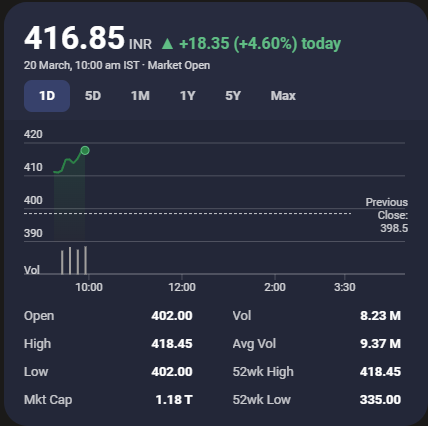
As of 20 March 2026, Tata Power’s share price is trading in the range of
₹398–₹404, showing steady strength in recent sessions. The stock recently touched an intraday gain of nearly
4%, driven by positive regulatory developments.

On 19 March 2026, the closing price stood around ₹398.50, with a day range between
₹393–₹404. The stock’s 52-week range lies between ₹326 and ₹495, with an all-time high near
₹494.85, indicating it is currently trading close to its recovery highs.

Tata Power


🚀 Big Catalyst: Gujarat PPA

The major trigger behind the recent surge is the approval of a revised
Power Purchase Agreement (PPA) for Tata Power’s
4 GW Mundra thermal plant by the Gujarat government.

This long-term deal, estimated to be worth over ₹30,000 crore, is expected to stabilize revenue streams
and improve capacity utilization. It also resolves long-standing regulatory uncertainties surrounding the Mundra project,
which had previously impacted investor sentiment.

📈 Financials & Analyst View

Tata Power’s latest quarterly results showed a slight 4% decline in revenue year-on-year, but
profit after tax improved modestly. This mixed performance initially caused a short-term dip, but the stock
quickly recovered.

Analysts remain optimistic due to the company’s strong presence in
renewable energy, smart grids, and improving margins in distribution and transmission.
Consensus price targets for the next 12 months are in the range of ₹410–₹425, suggesting limited but stable upside.

💡 What It Means for Investors

Tata Power is currently trading at a forward P/E ratio of 45–50, which appears premium compared to the broader market
but aligns with other large-cap power and renewable companies.

The stock’s short-term momentum remains positive due to the Gujarat PPA boost and strong institutional participation.
However, investors should closely monitor key risks such as:

  • Execution in renewable projects
  • Regulatory and tariff-related changes
  • Coal price volatility

Overall, Tata Power continues to show resilience, supported by strategic developments and long-term growth potential in India’s energy sector.

⚠️ Disclaimer

This content is for informational purposes only and should not be considered as financial or investment advice.
Stock market investments are subject to market risks. Please consult a certified financial advisor before making any investment decisions.


Read more

📉 March Market Pauses: When Trading Took a Break!

Market

"Pause the Trades, Plan the Profits!"

📌 Table of Contents

📅 March 2026 Holiday List

Indian stock markets, including NSE and BSE, observed multiple holidays in March 2026, affecting trading schedules amid global uncertainty.

  • March 3 (Tuesday): Holi
  • March 26 (Thursday): Shri Ram Navami
  • March 31 (Tuesday): Shri Mahavir Jayanti
  • March 21 (Saturday): Id-Ul-Fitr (Weekend holiday)

Markets remained completely closed for equity, derivatives, currency, and SLB segments on these dates.

📊 Trading Impact

March 2026 recorded the highest number of trading holidays in the year, shortening active trading sessions significantly.

  • Sensex saw a sharp intraday fall of nearly 2,700 points on March 2.
  • Nifty touched lows around 24,603 during this volatile phase.
  • Global tensions, especially US-Iran issues and rising oil prices, intensified uncertainty.
  • Commodity markets like MCX had partial operations, with some evening sessions open.

These breaks gave investors time to reassess portfolios and plan strategies.

✅ Official Confirmation

According to the latest update (March 16, 2026):

  • NSE officially confirmed all March holidays.
  • BSE followed the exact same schedule.
  • No special trading sessions (like Muhurat trading) were conducted.
  • Markets resumed normal trading immediately after each holiday.

💡 Key Takeaways

  • Total closures: 3 weekdays + 1 weekend
  • March had the highest holidays in 2026
  • Global volatility increased the importance of these breaks
  • No disruptions expected after March 31


Read more

Cupid Share Price Today: Bonus Bonanza Before the Big Reset

Cupid

“Massive Rally, Mega Bonus – Cupid Stock Enters a New Phase!”

Cupid Limited has been one of the most talked-about small-cap stocks in India over the past year.
After delivering massive multibagger returns, the stock is now witnessing volatility ahead of its
major corporate action — the 4:1 bonus issue. As of March 6, 2026, Cupid shares closed
around ₹402.20 on NSE, reflecting strong trading activity and investor interest.


Current Share Price Action

On March 6, 2026, Cupid Limited shares traded between ₹397 and ₹419.4 on the NSE before closing slightly lower at ₹402.20 (down 0.81%). Trading volumes remained strong with over 6.3 million shares exchanged during the session.

  • Market Cap: ₹10,793 – ₹10,942 crore
  • 52-Week Range: ₹55.75 – ₹526.95
  • 1-Year Return: 497% – 503%
  • Year-to-Date Return: -22.52%

Despite the recent correction from its highs, the stock remains a strong performer in the personal care and healthcare sector.

Cupid


4:1 Bonus Issue Details

The biggest catalyst for Cupid stock right now is its 4:1 bonus share issue.
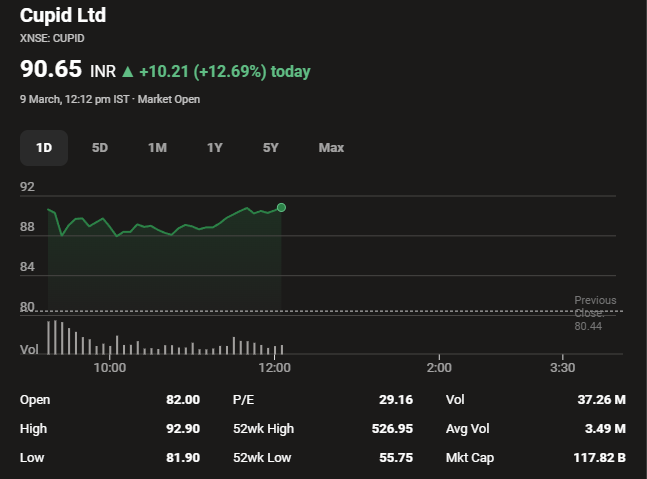
The company has fixed March 9, 2026 as the record date for this corporate action.

This means investors holding Cupid shares by the end of the trading session on March 9 will receive:

  • 4 fully paid-up shares for every 1 share held
  • Face value of each share: ₹1
  • Approximately 10.75 crore new shares to be issued
  • Deemed allotment date: March 10, 2026

Following the bonus issue, the share price will adjust downward proportionally. Analysts estimate the adjusted price could move near ₹80 levels, which may improve liquidity and retail participation.

Financial Highlights

Cupid Limited has delivered strong financial performance in FY26 so far.
The December 2025 quarter (Q3FY26) turned out to be its best quarter ever.

  • Quarterly Revenue: ₹93.50 crore
  • YoY Growth: 101.71%
  • FY26 Revenue Guidance: ₹335 crore
  • Expected PAT: ₹100 crore

Key Financial Ratios:

  • TTM EPS: ₹3.11
  • Price to Earnings (PE): 129.32
  • Sector PE: 52.92
  • Price to Book (P/B): 26.08
  • ROE: 12.9%
  • ROCE: 17.1%
  • Debt to Equity: 0.05 (almost debt free)

The company is also expanding globally and recently received approval to set up an FMCG manufacturing facility in Saudi Arabia, targeted for completion by March 2027.

Recent News & Market Sentiment

Cupid stock has remained highly volatile in recent months. After a 36% correction earlier this year, the stock rebounded nearly 26% in just two days following the Q3 update in January 2026.

On March 5, the stock even touched intraday highs around ₹409, reflecting renewed investor confidence.

However, there are some concerns as well:

  • Foreign institutional investor (FII/FPI) stake declined last quarter
  • High valuation multiples compared to industry peers
  • Possibility of post-bonus correction

Despite this, retail investor sentiment remains extremely bullish, with many community polls showing 100% buy sentiment.

Cupid’s product portfolio includes:

  • Male condoms
  • Female condoms
  • Personal lubricants
  • Healthcare products

Future Outlook for Investors

With the bonus issue becoming effective today, the share price is expected to adjust while liquidity improves significantly in the market.

Key Strengths:

  • Strong revenue and profit growth
  • Expanding global export market
  • New Saudi manufacturing facility
  • Low debt balance sheet

Key Risks:

  • High valuation compared to sector
  • Short-term volatility after bonus issue
  • Dependence on export markets

Many analysts believe Cupid still holds long-term multibagger potential, but investors will closely watch upcoming Q4FY26 results for confirmation of sustained growth momentum.

Disclaimer

This article is for informational and educational purposes only and should not be considered financial or investment advice. Stock market investments are subject to market risks, and past performance does not guarantee future returns. Readers are advised to consult a qualified financial advisor before making
any investment decisions.


Read more

Sensex Slides 1000 Points: Is This a Warning or Just a Pause?

Sensex

Markets Shake, Investors Awake!

Indian stock markets witnessed a sharp intraday reversal as the Sensex plunged nearly 700–1000 points from its peak, while Nifty slipped below the 25,600 mark. The broad-based sell-off wiped out significant investor wealth and triggered volatility across sectors.

1. What Happened Today?

After three consecutive sessions of strong gains — where Sensex rallied over 1,100 points driven by positive Q3 earnings — markets saw aggressive profit booking. The sudden reversal caught traders off guard as selling intensified throughout the session.

Simultaneously, India VIX surged 7.45% to 13.13, indicating a spike in fear and short-term uncertainty.

2. Key Domestic Triggers

  • Profit Booking: Investors locked in gains after recent rally.
  • F&O Expiry Pressure: Derivative expiry amplified volatility.
  • Technical Selling: Resistance levels triggered algorithmic selling.
  • Heavyweight Drag: Banking and FMCG majors pulled indices lower.

Midcap and smallcap stocks faced sharper declines, signaling broader market weakness rather than isolated selling.

3. Global Market Pressures

Global cues further dampened sentiment:

  • Asian markets like Nikkei and Hang Seng traded lower.
  • European indices declined over 1%.
  • Renewed US trade tensions and tariff threats created uncertainty.
  • Brent crude rose to $70.49 amid geopolitical tensions, raising inflation concerns.
  • Weak US job data revisions signaled slowing growth.

Rising oil prices particularly hurt oil-sensitive sectors and added pressure to inflation outlook.

4. Sector-Wise Impact

  • Banking: Sharp declines led the fall.
  • Metals: Heavy selling pressure.
  • FMCG: Defensive stocks also corrected.
  • IT: Offered limited cushion but could not prevent broader decline.
  • Midcaps: Witnessed steeper fall compared to large caps.

The correction was broad-based, indicating fragile investor sentiment.

5. Important Technical Levels

  • Nifty Support: 25,660
  • Nifty Resistance: 26,000
  • Volatility Indicator: India VIX rising trend

Market participants are closely watching whether buying interest returns after derivative expiry.

6. What Should Investors Do?

Experts suggest avoiding panic selling. This correction appears driven by short-term triggers rather than systemic weakness. Long-term investors should:

  • Stay disciplined and avoid emotional decisions.
  • Monitor crude prices and global geopolitical developments.
  • Track foreign institutional investor (FII) flows.
  • Focus on fundamentally strong companies.

The market shake-up reflects fragile sentiment, not structural collapse. Volatility may persist, but disciplined investors often find opportunity in such phases.


Disclaimer

The information provided in this article is for informational and educational purposes only and should not be considered financial, investment, or trading advice. Readers are advised to consult a certified financial advisor or conduct their own research before making any investment decisions.

Read more

Jio IPO 2026: India’s Biggest Listing in the Making

Jio

“From Telecom Giant to Market Titan.”

Reliance Jio Platforms, the digital powerhouse of Reliance Industries led by Mukesh Ambani, is preparing for a historic IPO in the first half of 2026. If executed as planned, it could become India’s largest IPO ever, reshaping the country’s capital markets and redefining telecom valuations.

Table of Contents

Jio IPO Details

According to recent reports, Jio Platforms is considering an offer-for-sale (OFS) of around 2.5% equity. At current estimates, this could raise more than $4 billion, valuing the company between $180–240 billion.

Jefferies’ November 2025 assessment pegged Jio at $180 billion, implying a potential $4.5 billion raise. The plan also aligns with SEBI’s proposed rule change that reduces minimum public shareholding for large companies from 5% to 2.5%, easing the path for mega listings.

Mukesh Ambani had earlier confirmed the IPO timeline as H1 2026, subject to market conditions and regulatory approvals. At the upper valuation band, Jio’s listing would far exceed last year’s Hyundai Motor India IPO, which raised $3.3 billion.

Strategic Context

Jio Platforms is India’s largest telecom operator with over 500 million subscribers. Beyond telecom, the company has rapidly diversified into AI, cloud, digital services, and media.

A key growth lever is Jio’s partnership with Nvidia to build AI infrastructure in India. Meanwhile, Jio continues to lead in 5G fixed wireless access (FWA), even as global players like Starlink prepare to enter the Indian market.

JM Financial expects the IPO to act as a catalyst for the telecom sector, projecting a 12% ARPU CAGR through FY28, supported by tariff hikes, rising postpaid users, and deeper 5G penetration.

Recent Developments

In early February 2026, Jio Studios acquired a 50.1% stake in Oscar-winning Sikhya Entertainment, strengthening its content and media ambitions.

Over the past six years, Jio Platforms has attracted marquee global investors such as KKR, General Atlantic, Silver Lake, and Abu Dhabi Investment Authority. These investments have reinforced confidence in Jio’s long-term cash flow visibility.

With premium 5G plans, higher data usage, and the gradual exit from low-end plans, Jio’s free cash flow outlook continues to improve.

Market Impact & Outlook

The Jio Platforms IPO is expected to be a defining moment for Indian capital markets. It signals the maturity of India’s telecom sector, driven by tariff resets, technology upgrades, and monetization of 4G and 5G broadband services.

For investors, the listing represents a rare opportunity to participate directly in one of India’s most influential digital ecosystems—spanning telecom, AI, media, and next-generation connectivity.

If valuations hold and market conditions remain supportive, Jio’s IPO could set new benchmarks for size, scale, and ambition in India’s stock market history.

Read more

Adani Stocks Sink as US SEC Heat Intensifies

Stocks

“Big Names, Bigger Scrutiny – Markets React Fast.”

Market Reaction on January 23, 2026

Adani Group stocks faced heavy selling pressure on January 23, 2026, wiping out nearly $12.5 billion in market capitalization. The sharp fall came amid fresh developments in the ongoing US SEC investigation and weaker-than-expected quarterly results from key group companies.

While the Nifty slipped just 0.95%, most Adani stocks significantly underperformed, reflecting heightened investor caution.


Major Adani Stock Declines

US SEC Probe: What Triggered the Sell-Off

The sell-off intensified after reports that the US Securities and Exchange Commission (SEC) sought court approval to email summons directly to Gautam Adani and Sagar Adani.

The case relates to an alleged $265 million bribery and fraud scheme linked to solar power contracts involving Adani Green Energy. The allegations, unsealed in November 2024, accuse the group of violating US securities laws through misleading disclosures.

Adani Group has strongly denied the allegations, calling them baseless and stating it will pursue all legal remedies.


Key Financial Highlights

Adani Energy Solutions reported mixed Q3 FY26 results:

  • Net profit declined 8% YoY to Rs 574 crore.
  • Revenue grew 15.7% YoY to Rs 6,944 crore.
  • EBITDA touched a record high.
  • Profit before tax rose 43% YoY to Rs 801 crore.

However, higher tax expenses offset operational gains, adding to investor disappointment.


Analyst View & Outlook

Analysts believe that despite strong operational performance in several Adani businesses, regulatory uncertainty remains a key overhang. Year-to-date 2026, most Adani stocks have lagged broader benchmarks.

Market experts advise a cautious approach until greater clarity emerges on the US SEC probe, even as the group continues to highlight its long-term infrastructure and energy growth story.

Bottom Line: Until legal clouds clear, Adani stocks may remain volatile, with sentiment-driven moves outweighing fundamentals.


Read more

Sensex Rises but Volatility Looms 📊

Sensex

Markets move up, but caution stays alive.

Market Opening

Indian stock markets opened on a positive note on January 16, 2026, showing cautious optimism after a holiday break. The BSE Sensex jumped 277 points to trade near 83,660, while Nifty moved above 25,800.

Buying interest was seen in IT, realty, and PSU banks following select Q3 business updates. However, sentiment remained mixed as foreign institutional investors (FIIs) continued selling for the seventh straight session, offloading nearly ₹1,500 crore.


Sectoral Gainers

Metal stocks led the rally, with the Nifty Metal index rising 2.7%, touching fresh highs due to global commodity price strength.

  • Tata Steel surged 3.66% to ₹189.25
  • NTPC gained 3.31% to ₹349
  • Axis Bank climbed 2.92%, boosting PSU and banking sentiment

PSU banks rose over 2%, supported by healthy operational updates and stable asset quality expectations.


Key Decliners

The IT sector underperformed, slipping 1.1%, as cautious outlooks weighed on sentiment.

Realty and auto stocks saw mild selling pressure due to weak demand visibility.


Market Outlook & Key Levels

Analysts expect markets to remain range-bound, with India VIX on the rise, indicating higher intraday volatility.

  • Nifty Resistance: 26,000 – 26,500
  • Nifty Support: 25,000 and 24,500
  • Bank Nifty Range: 59,500 – 60,000

A break below 59,400 in Bank Nifty could trigger a fall toward 59,000, while DII buying may limit sharp downside.

Sensex


Broader Market Context

Gift Nifty signaled a flat start, in line with overnight US market gains. Investors are closely watching Q3 results from Wipro and Reliance Industries.

Meanwhile, SEBI approved IPO proposals worth over ₹6,000 crore, reflecting a strong primary market pipeline. Changes in commodity derivatives may also attract more institutional participation going ahead.

Markets are up, but volatility and FII selling demand caution.

Disclaimer: Yeh views market experts ke hain and not of trueincome. Investment karne se pehle certified advisor se consult zaroor karein.

Read more

Nifty 50 Slips as Volatility Spikes: Is the Market Entering a Danger Zone?

Nifty 50

“Markets don’t fall quietly — they send signals first.”
India’s benchmark index, Nifty 50, is showing clear signs of stress as early January 2026 begins with heightened volatility and cautious investor sentiment.

On January 9, Nifty 50 opened slightly weak near 25,840 and extended losses through the day, slipping below 25,900. By afternoon trade, the index was down nearly 0.7%, reflecting nervousness ahead of key global and domestic triggers.

📊 Recent Market Performance

The correction has been sharp. Over the last five trading sessions, Nifty has dropped more than 2%, while the Sensex has lost over 2,000 points cumulatively. This comes after a flat start to the year, when Nifty closed around 26,150 on January 1.

Earlier, stocks like NTPC, Bajaj Auto, Wipro, Eternal, and Shriram Finance supported the index. However, heavyweights such as ITC, Bajaj Finance, Dr Reddy’s, ONGC, and Tata Consumer dragged markets lower. Sector-wise, FMCG slipped nearly 3%, while pharma declined 0.4%. Autos, IT, metals, power, telecom, and PSU banks showed limited gains earlier in the week.

Broader markets were relatively resilient, with midcaps rising 0.3% and smallcaps staying flat on January 1.

🌍 What’s Driving the Decline?

Global uncertainty remains the biggest concern. Weak US market cues, delays in the India–US trade deal, and caution ahead of Q3 earnings season have dented risk appetite.

Stocks like NTPC, Adani Enterprises, ICICI Bank, Maruti Suzuki (down 3%), and Titan have emerged as top drags. Bank Nifty underperformed, slipping below 59,400, with strong resistance placed near 60,000–60,300.

📈 Technical Outlook

Technically, Nifty is holding above short-term moving averages but continues to form bearish candles with long lower shadows — a sign that buyers may step in if supports hold.

Analysts are watching 25,840 as immediate support, while 26,150–26,200 remains a critical resistance zone. A decisive breakout above this level could revive momentum.

🚀 Stocks in Focus

  • Gainers: Vodafone Idea, Indus Towers (up 4–6%)

  • Losers: ICICI Bank, Bajaj Finance, Bajaj Finserv, ITC, BEL

Gold prices remain steady ahead of US jobs data, adding to equity market uncertainty. For now, investors are closely tracking earnings results and global trade updates for the next market cue.

Disclaimer: Yeh views market experts ke hain and not of trueincome. Investment karne se pehle certified advisor se consult zaroor karein.

Read more