Sensex Soars 2.6% – Markets Bounce Back with Massive Rally

Markets

Big Bull Run Returns: ₹13 Lakh Crore Wealth Created in Hours!

📌 Table of Contents


📊 Opening Performance

Indian stock markets kicked off April 1, 2026, with a powerful rally after a weak FY26 close.
The BSE Sensex surged over 1,900 points (2.66%) to 73,859 by early trading, rebounding from Monday’s close of 71,947.
Similarly, the NSE Nifty 50 jumped 2% to 22,912, reflecting strong bullish sentiment across sectors.

🚀 Key Drivers

  • Improved global sentiment after signals of possible de-escalation in US-Iran tensions.
  • Strong opening cues from GIFT Nifty, indicating a gap-up start.
  • Massive wealth creation of ₹13 lakh crore within the first hour.
  • Continued support from Domestic Institutional Investors (DIIs) despite FII selling.

📈 Top Gainers & Losers

  • Trent: +6.70% (₹3,516)
  • BEL: +6.13% (₹425)
  • Shriram Finance: +5% (₹919)
  • Adani Ports: +5.13% (₹1,380)
  • Bajaj Finance: +4.72% (₹839)

Broad-based buying was seen across sectors, with defence and financial stocks leading the rally.

📉 FY26 Context

Despite today’s surge, markets closed FY26 in the red.
The Sensex declined around 7% (5,467 points), while Nifty dropped 5% (1,200 points),
due to global uncertainties and domestic pressures.
India VIX rose to 27.89, indicating higher volatility, while market valuations remained around a P/E of 19.8–20.2.

🔮 Outlook & Key Levels

Analysts expect short-term bullish momentum to continue, with key levels to watch:

  • Nifty Support: 22,400 | Resistance: 23,200
  • Sensex Support: Around 73,000

Upcoming market holidays on April 3 (Good Friday) and April 14 (Ambedkar Jayanti) may impact trading volumes.
Investors are also tracking key stocks like IndiGo, Bharti Airtel, and GRSE for further cues.



Read more

Sensex Roars Back 970 Points – Bulls Strike After Panic Sell-Off

Sensex

From Fear to Fire: Markets Bounce Back Strong!

📌 Table of Contents

📊 Market Opening

Indian stock markets staged a sharp rebound on March 20, 2026, recovering from yesterday’s steep 3.26% fall.
The Sensex surged nearly 970 points (~1.3%) to around 75,178, while Nifty crossed 23,300.
Markets opened positive, with Sensex at 74,559 and Nifty at 23,110, supported by easing crude oil prices and improved global sentiment.

Sensex


🚀 Key Drivers

  • Cooling crude oil prices from $118 peak reduced inflation fears.
  • Geopolitical relief signals from global leaders boosted confidence.
  • Positive cues from GIFT Nifty and Asian markets.
  • Sectoral strength led by IT, banking, and metals.

📈 Top Performers

  • Banking: Nifty Bank rose 1.35% to 54,173; SBI gained 0.79%.
  • IT: Nifty IT climbed 1.30% to 28,952.
  • Metals: BSE Metals jumped 2.26%.

However, HDFC Bank declined around 2% following the chairman’s resignation, though analysts remain optimistic about its long-term outlook.

⚠️ Concerns

  • Foreign investors sold ₹7,558 crore in the previous session.
  • Rupee hit a record low of 92.94 against the dollar.
  • Oil price risks remain if geopolitical tensions escalate.
  • Volatility continues as broader markets remain under pressure.

🔮 Market Outlook

Markets have regained bullish momentum with Sensex nearing the 75,000 mark.
Key support for Nifty stands around 22,900. Analysts suggest watching crude oil prices, rupee movement, and FII activity closely.
Short-term opportunities are visible in IT and banking sectors, while overall sentiment depends on global stability.

⚠️ Disclaimer

This article is for informational purposes only and does not constitute financial advice.
Investors should conduct their own research or consult a financial advisor before making any investment decisions.
Market investments are subject to risks.


Read more

Sensex Crash: ₹7 Lakh Crore Wiped Out in Minutes

Crash

Market Meltdown: Oil Shock & Global Tensions Shake Dalal Street!

Table of Contents


Market Overview

Indian stock markets witnessed a sharp crash today, with the BSE Sensex plunging over 1,600 points and the Nifty50 slipping below 23,300. Within minutes of opening, investors lost nearly ₹7 lakh crore in market value, triggering widespread panic selling.

Key Triggers

  • Crude Oil Surge: Global oil prices jumped above $110–112 per barrel amid rising US-Iran tensions, raising inflation concerns.
  • Fed Decision: The US Federal Reserve kept rates unchanged at 3.50%-3.75%, disappointing hopes of rate cuts.
  • FII Selling: Foreign Institutional Investors sold over ₹56,000 crore in March, intensifying pressure.
  • Weak Global Cues: Asian markets fell sharply, with Japan’s Nikkei dropping 2.61%.

Index Performance

  • Sensex: Fell 1,618–1,800 points (2.1%–2.55%) to around 75,085–74,750.
  • Nifty50: Dropped 483–535 points (2.03%–2.44%) to 23,277–23,197.

All Sensex stocks traded in the red. Major losers included HDFC Bank, L&T, Axis Bank, M&M, and Bajaj Finance, each falling over 2%. The Nifty Bank index also declined by 2.53%.

Sector Impact

Oil-sensitive sectors such as aviation, paints, and chemicals faced margin pressure due to rising crude prices. Banking and auto stocks declined amid interest rate concerns and rupee weakness (USD/INR near 92.92). IT, metals, and FMCG sectors also saw broad-based selling due to panic and technical breakdowns.

Global Context

Global markets remained volatile. While US markets showed mixed performance—Dow Jones fell 1.63% and Nasdaq rose 0.16%—Asian markets declined sharply due to geopolitical tensions and rising oil prices. Brent crude has surged over 40% since late February due to supply disruptions linked to Middle East conflicts. Gold prices dipped slightly despite safe-haven demand.

Investor Outlook

Domestic Institutional Investors (DIIs) provided some support by buying ₹3,253 crore worth of equities. However, continued FII outflows and global uncertainty remain key risks. Investors are closely monitoring crude oil trends, Federal Reserve signals, and geopolitical developments for signs of market recovery.


Read more

📉 Market Meltdown: Sensex Sinks 1,068 Points as IT Stocks Trigger Panic Selloff

Sensex

"AI Fears Shake Dalal Street — Bulls Retreat, Bears Take Charge!"

📌 Table of Contents

📊 Market Performance Overview

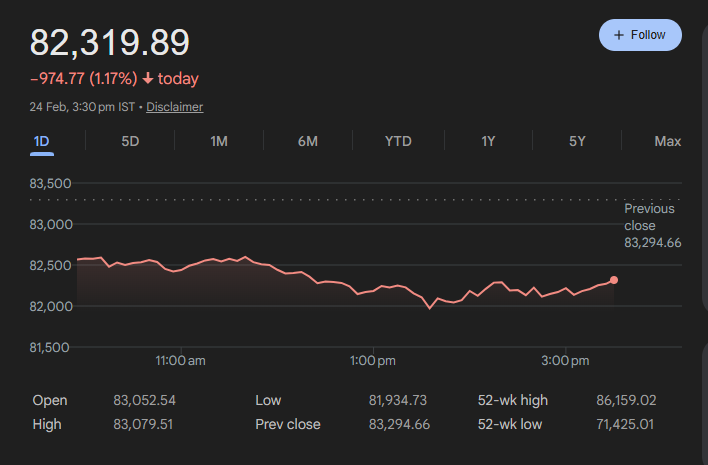
Indian equity benchmarks closed sharply lower on February 24, 2026, snapping a two-day winning streak amid aggressive selling in IT stocks.

The BSE Sensex plunged 1,068.74 points (-1.28%) to settle at 82,225.92, marking its lowest closing since early February.

The NSE Nifty 50 dropped 288.35 points (-1.12%) to close at 25,424.65, after slipping below 25,350 intraday on F&O expiry day.

Broader markets also weakened:

  • Nifty Midcap fell 0.3%
  • Nifty Smallcap declined 0.55%

The sharp decline was driven by growing fears of AI-led disruption in IT services, combined with uncertainties around US tariff policies and global trade tensions.

Sensex

🏦 Key Sectoral Movements

💻 IT Sector Leads the Crash

Nifty IT nosedived 4.74%, shedding nearly 1,497 points to close at 30,053.50. The index is now heading toward its worst monthly performance since 2008.

Concerns intensified as AI automation tools threaten traditional coding and outsourcing services.

🏠 Realty & Banking

  • Nifty Realty dropped between 2.5%–3%
  • Nifty Bank slipped 0.35% to 61,047.30

⛏️ Metals Shine Amid Oil Surge

Metal stocks gained nearly 1%, supported by rising crude oil prices nearing seven-month highs due to US-Iran geopolitical tensions.

📈 Index Performance Snapshot

Index Close Change % Change
Sensex 82,225.92 -1,068.74 -1.28%
Nifty 50 25,424.65 -288.35 -1.12%
Nifty Bank 61,047.30 -216.95 -0.35%
Nifty IT 30,053.50 -1,497.00 -4.74%

📌 Top Gainers & Losers

🔻 Major Draggers

  • Infosys
  • TCS
  • IT heavyweights pulling indices lower

The IT index has corrected over 10,000 points from its February peak.

🔼 Notable Gainers

  • Indoco Remedies (+7%) after USFDA approval
  • Waaree Energies (+4%) on strong solar order
  • Adani Ports previously gained nearly 3%

FII Activity: Sold ₹103 crore
DII Activity:</strong Bought ₹3,161 crore

🌍 Global Cues & Market Outlook

Technical indicators show growing bearish momentum:

  • Resistance at 25,530
  • Support at 25,360
  • VIX warning of deeper correction below 25,200

Global pressure continues from:

  • Wall Street weakness amid AI concerns
  • Mixed Asian & European markets
  • Uncertainty over US tariff decisions

However, Gift Nifty signals a potential mild rebound.

Equity turnover surged to a 16-month high of ₹23.9 lakh crore in February, highlighting heightened volatility.

📢 Final Take

The market mood has shifted decisively toward caution. With AI disruption fears rising and global trade tensions escalating, volatility may remain elevated.

Investors should closely monitor US policy clarity and upcoming Q4 earnings for directional cues.

Dalal Street Reminder: In volatile times, disciplined strategy beats emotional trading.


Read more

Sensex Slides 1000 Points: Is This a Warning or Just a Pause?

Sensex

Markets Shake, Investors Awake!

Indian stock markets witnessed a sharp intraday reversal as the Sensex plunged nearly 700–1000 points from its peak, while Nifty slipped below the 25,600 mark. The broad-based sell-off wiped out significant investor wealth and triggered volatility across sectors.

1. What Happened Today?

After three consecutive sessions of strong gains — where Sensex rallied over 1,100 points driven by positive Q3 earnings — markets saw aggressive profit booking. The sudden reversal caught traders off guard as selling intensified throughout the session.

Simultaneously, India VIX surged 7.45% to 13.13, indicating a spike in fear and short-term uncertainty.

2. Key Domestic Triggers

  • Profit Booking: Investors locked in gains after recent rally.
  • F&O Expiry Pressure: Derivative expiry amplified volatility.
  • Technical Selling: Resistance levels triggered algorithmic selling.
  • Heavyweight Drag: Banking and FMCG majors pulled indices lower.

Midcap and smallcap stocks faced sharper declines, signaling broader market weakness rather than isolated selling.

3. Global Market Pressures

Global cues further dampened sentiment:

  • Asian markets like Nikkei and Hang Seng traded lower.
  • European indices declined over 1%.
  • Renewed US trade tensions and tariff threats created uncertainty.
  • Brent crude rose to $70.49 amid geopolitical tensions, raising inflation concerns.
  • Weak US job data revisions signaled slowing growth.

Rising oil prices particularly hurt oil-sensitive sectors and added pressure to inflation outlook.

4. Sector-Wise Impact

  • Banking: Sharp declines led the fall.
  • Metals: Heavy selling pressure.
  • FMCG: Defensive stocks also corrected.
  • IT: Offered limited cushion but could not prevent broader decline.
  • Midcaps: Witnessed steeper fall compared to large caps.

The correction was broad-based, indicating fragile investor sentiment.

5. Important Technical Levels

  • Nifty Support: 25,660
  • Nifty Resistance: 26,000
  • Volatility Indicator: India VIX rising trend

Market participants are closely watching whether buying interest returns after derivative expiry.

6. What Should Investors Do?

Experts suggest avoiding panic selling. This correction appears driven by short-term triggers rather than systemic weakness. Long-term investors should:

  • Stay disciplined and avoid emotional decisions.
  • Monitor crude prices and global geopolitical developments.
  • Track foreign institutional investor (FII) flows.
  • Focus on fundamentally strong companies.

The market shake-up reflects fragile sentiment, not structural collapse. Volatility may persist, but disciplined investors often find opportunity in such phases.


Disclaimer

The information provided in this article is for informational and educational purposes only and should not be considered financial, investment, or trading advice. Readers are advised to consult a certified financial advisor or conduct their own research before making any investment decisions.

Read more

STT Shock in Budget 2026

Budget

“Speculation Gets Costlier, Discipline Gets Cheaper.”


Union Budget 2026-27 delivered a major jolt to Dalal Street as Finance Minister
Nirmala Sitharaman announced a sharp hike in
Securities Transaction Tax (STT) on futures and options.
The move triggered an instant market sell-off and reignited debate around
speculation, revenue, and retail trader protection.

📌 Table of Contents

📊 What Changed in STT?

The government announced higher STT rates across the derivatives segment,
making futures and options trading significantly more expensive.

Segment Old STT Rate New STT Rate
Futures 0.02% 0.05%
Options (Premium) 0.10% 0.15%
Options (Exercise) 0.125% 0.15%

These changes aim to discourage excessive speculation, especially among
retail traders active in F&O markets.

📉 Market Reaction: Sensex Crashes

Markets reacted instantly after the announcement:

  • Sensex plunged 1,547 points
  • Heavy selling in banking and brokerage stocks
  • F&O-heavy traders rushed to cut positions

Higher transaction costs raised fears of lower trading volumes,
especially in the derivatives segment that dominates daily turnover.

💰 Why the Government Raised STT

STT collections fell short of expectations despite booming derivatives volumes:

  • FY26 STT target: ₹78,000 crore
  • Collected till Jan 1: ₹45,000 crore
  • Estimated FY26 total: ₹57,000 crore (25% shortfall)

The hike is designed to plug this gap and extract more revenue from
high-frequency and high-volume trading activity.

🧠 Experts & Industry Reactions

Market veteran Shankar Sharma supported the move, calling
unrestricted F&O trading a “poison” for retail investors and welcoming
steps to reduce speculative addiction.

Brokers, however, criticized the hike and demanded:

  • Restoration of Section 88E tax rebates
  • Clarity on physical settlement-related STT

Some analysts believe the real target is high-frequency and algorithmic traders
rather than individual investors.

⚙️ Other Key Budget Reforms

Alongside STT changes, the budget introduced corporate tax simplifications:

  • MAT reduced from 15% to 14% (effective April 2026)
  • No new MAT credit accumulation
  • Push toward simplified new tax regime

Direct tax collections hit ₹17.78 lakh crore by February 10,
up 14.69% year-on-year, with STT collections surging 65%.

⚠️ What This Means for Traders & Markets

The STT hike could:

  • Reduce F&O volumes
  • Protect novice traders from heavy losses
  • Increase trading costs across the board

Meanwhile, the Supreme Court is examining the constitutional validity of STT,
keeping the debate alive. While sectors like electronics rallied after
₹40,000 crore allocations, derivatives markets now face strong headwinds.


Budget 2026 walks a tightrope—boosting revenue
and curbing speculation while risking short-term market volatility.
For traders, discipline just became more expensive.


Read more

Nifty 50 on Edge Before Budget 2026

Nifty

“Budget Day, Big Moves — Markets Hold Their Breath”

The Nifty 50 ended Friday on a cautious note as investors stepped back ahead of the highly anticipated Union Budget 2026. While domestic benchmarks slipped, GIFT Nifty signals a flat-to-muted opening for Sunday, February 1, reflecting uncertainty before the Finance Minister’s big announcements.

Table of Contents

Recent Market Performance

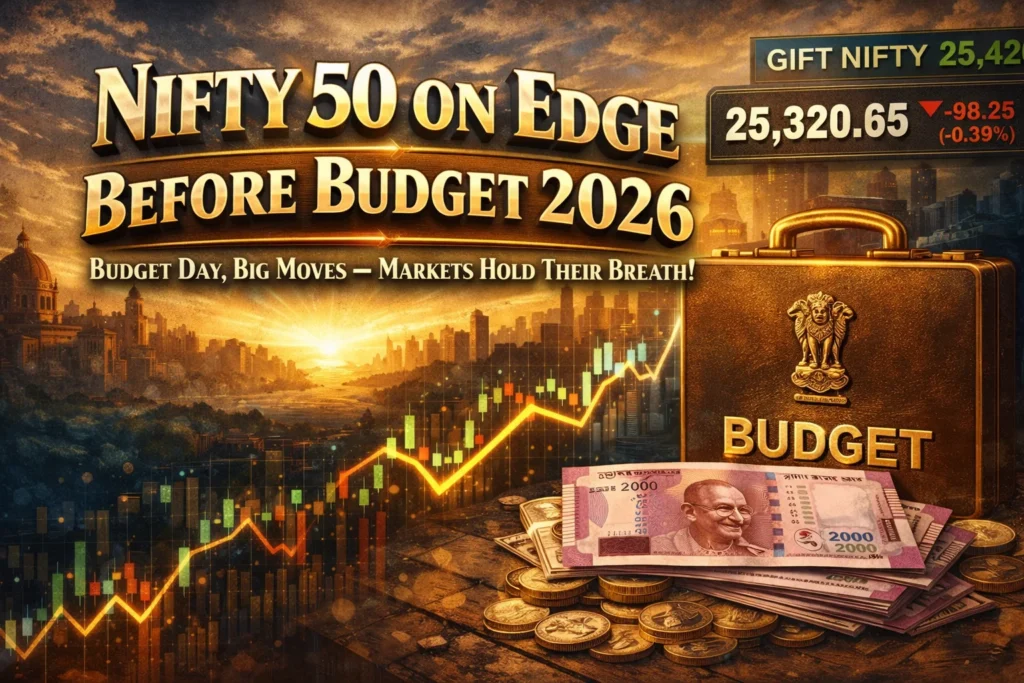
On January 30, the benchmark Nifty 50 closed at 25,320.65, slipping 98.25 points (0.39%) from the previous close of 25,418.90. The index oscillated between an intraday low of 25,213.65 and a high of 25,370.70.

Trading activity remained healthy with volumes of 5,083.89 lakh shares and a turnover of ₹40,771.81 crore. Despite near-term pressure, Nifty has delivered an 8.91% return over the past year, though it remains down 3.16% YTD.

Key Index Metrics

  • P/E Ratio: 22.04
  • P/B Ratio: 3.44
  • Dividend Yield: 1.30%
  • Free-Float Market Cap: ₹115.17 lakh crore

Market breadth stayed balanced with 25 stocks advancing and 25 declining. Heavyweights like Reliance Industries, HDFC Bank, and Bharti Airtel continued to dominate index movement.

Market Outlook & Levels to Watch

Early Sunday trade in GIFT Nifty hovered near 25,420, hinting at a flat opening as traders await Budget cues. The index recently snapped a three-day rally due to FII selling, rupee weakness, and pressure in banking and metal stocks.

Technical levels to watch:
Support is placed at 25,200–25,300 near the 200-day EMA, while immediate resistance stands at 25,500. A decisive move beyond this range could set the tone for the coming weeks.

Union Budget 2026: What Markets Expect

Finance Minister Nirmala Sitharaman presents the Union Budget today, with investors tracking announcements on capital expenditure, tax reforms, rural spending, and consumption-led growth.

Sectors like agriculture, digital infrastructure, NBFCs, and manufacturing are in focus. Pharma and auto stocks reported mixed Q3 earnings, while metals weakened ahead of the event. Analysts expect heightened volatility but policy continuity.

Global Market Cues

Global sentiment remains mixed. US Dow futures fell 0.40% and Nasdaq futures slid 0.95%, while Europe’s FTSE gained 0.51%. Asian markets were uneven with Nikkei down 0.10% and Hang Seng slipping 1.98%.

Persistent FII outflows and global uncertainty, including developments around US Fed leadership, continue to weigh on Indian equities.

With Budget 2026 in focus, Nifty stands at a crucial crossroads. Traders should brace for sharp swings as policy announcements decide whether the index breaks higher — or slips below key support.


Disclaimer: Yeh views market experts ke hain and not of trueincome. Investment karne se pehle certified advisor se consult zaroor karein.

Read more

Sensex Rises but Volatility Looms 📊

Sensex

Markets move up, but caution stays alive.

Market Opening

Indian stock markets opened on a positive note on January 16, 2026, showing cautious optimism after a holiday break. The BSE Sensex jumped 277 points to trade near 83,660, while Nifty moved above 25,800.

Buying interest was seen in IT, realty, and PSU banks following select Q3 business updates. However, sentiment remained mixed as foreign institutional investors (FIIs) continued selling for the seventh straight session, offloading nearly ₹1,500 crore.


Sectoral Gainers

Metal stocks led the rally, with the Nifty Metal index rising 2.7%, touching fresh highs due to global commodity price strength.

  • Tata Steel surged 3.66% to ₹189.25
  • NTPC gained 3.31% to ₹349
  • Axis Bank climbed 2.92%, boosting PSU and banking sentiment

PSU banks rose over 2%, supported by healthy operational updates and stable asset quality expectations.


Key Decliners

The IT sector underperformed, slipping 1.1%, as cautious outlooks weighed on sentiment.

Realty and auto stocks saw mild selling pressure due to weak demand visibility.


Market Outlook & Key Levels

Analysts expect markets to remain range-bound, with India VIX on the rise, indicating higher intraday volatility.

  • Nifty Resistance: 26,000 – 26,500
  • Nifty Support: 25,000 and 24,500
  • Bank Nifty Range: 59,500 – 60,000

A break below 59,400 in Bank Nifty could trigger a fall toward 59,000, while DII buying may limit sharp downside.

Sensex


Broader Market Context

Gift Nifty signaled a flat start, in line with overnight US market gains. Investors are closely watching Q3 results from Wipro and Reliance Industries.

Meanwhile, SEBI approved IPO proposals worth over ₹6,000 crore, reflecting a strong primary market pipeline. Changes in commodity derivatives may also attract more institutional participation going ahead.

Markets are up, but volatility and FII selling demand caution.

Disclaimer: Yeh views market experts ke hain and not of trueincome. Investment karne se pehle certified advisor se consult zaroor karein.

Read more

HDFC Bank Shares Fall After Q3 Update: Is This a Warning or a Buying Opportunity?

HDFC Bank

“HDFC Bank Slips, But Smart Money Isn’t Panicking — Here’s Why”

HDFC Bank shares came under pressure after its Q3 FY26 business update, dragging the stock to a three-month low near ₹956. The fall also weighed on benchmark indices like Sensex and Nifty, raising concerns among short-term investors.

But beneath the surface, the numbers tell a more balanced story.

📉 What Happened to the Stock?

On January 6, 2026, HDFC Bank shares dropped over 2%, extending losses for the second straight session. The stock traded in the ₹950–₹962 range, underperforming the private banking sector.

Heavy trading volumes — over ₹87,000 crore — showed strong investor activity, though sentiment remained mixed. The stock also fell below its 200-day moving average after losing nearly 5% in just two days, largely due to foreign institutional investor (FII) selling.

📊 Q3 FY26 Business Update: Growth, But Slower Than Expected

Despite the market reaction, HDFC Bank reported healthy year-on-year growth:

  • Average advances rose 9% to ₹28.64 lakh crore

  • Loan book growth reached 12%, post-merger normalization

  • Deposits grew 11.5% to ₹28.59 trillion

  • Credit-to-deposit ratio edged up to 98.5%

While these figures indicate solid expansion, analysts noted a sequential slowdown, especially in deposit mobilisation, which disappointed the market.

🧠 What Are Analysts Saying?

Brokerages largely called the update “in-line”, but flagged near-term concerns.
MarketsMojo upgraded the stock to “Strong Buy”, giving it a score of 80, citing strong fundamentals and long-term stability.

Key long-term indicators remain supportive:

  • 3-year ROE: 16.12%

  • Strong loan growth trend

  • Rising mutual fund ownership, even as FIIs reduce exposure

Short-term consolidation is expected, but institutional confidence hasn’t faded.

🌐 Bigger Picture: Why Long-Term Investors Are Still Calm

In Q2 FY26, HDFC Bank posted a 20.62% jump in profit to ₹19,611 crore, boosting earlier optimism. The bank’s CASA ratio stands at 34.8%, and its 5-year CAGR exceeds 11%.

With a massive market cap of ₹14.8 lakh crore and delivery volumes jumping 95–122%, HDFC Bank continues to dominate India’s private banking space.

While short-term volatility may persist, long-term fundamentals remain strong. For patient investors, this correction could be more of an opportunity than a threat.

📌 HDFC Bank may be under pressure today — but its core strength remains intact.

Disclaimer: Yeh views market experts ke hain and not of trueincome. Investment karne se pehle certified advisor se consult zaroor karein.

Read more