
NIFTY 50 Crashes 336 Points — Will Bulls Bounce Back Monday?

NIFTY

Volatility Returns. Support Tested. Monday Decides the Mood.

Closing Performance Snapshot

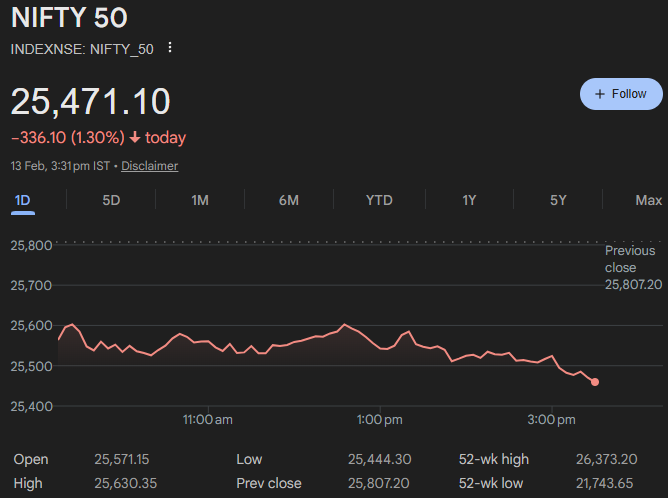
The NIFTY 50 index closed sharply lower on Friday, February 13, 2026, dragged down by heavy selling in IT and metal stocks.

  • Closing Level: 25,471.10
  • Loss: 336.10 points (-1.30%)
  • Day’s Low: 25,444.30
  • Opening: 25,571.15

This marked the second consecutive session of decline, with the index slipping below the crucial 25,500 level. Meanwhile, the Sensex tanked over 1,000 points, reflecting broad market weakness.

Volatility spiked significantly as India VIX surged 13.36% to 13.29, indicating rising fear among traders.

However, GIFT NIFTY futures suggest a mildly positive start on Monday, February 16, trading near 25,520 (+0.26%).
NIFTY

Key Sector Moves

  • NIFTY IT: Fell 1.44% to 32,681.50 amid AI concerns and weak global tech cues.
  • Metals: Plunged 3.31% to 11,872.80 due to soft global commodity prices.
  • FMCG: Dropped 1.90%.
  • Bank Nifty: Declined 0.91% to 60,186.65, outperforming broader markets supported by private banks.

Broader markets underperformed further:

  • NIFTY Midcap 100: Down 1.71%
  • Smallcaps also witnessed sharp selling pressure.

Top Gainers & Losers

Major Drags:

  • HUL – Down 4%
  • Eternal – Down 4%
  • TechM – Down 6%
  • HCL Tech – Down 5%

Relatively Better Performer:

  • Bajaj Finance contributed positively during the session but ended lower at ₹1,024.75.

The weakness remained broad-based with limited defensive support.

Technical Outlook & Key Levels

From a technical perspective, the market now stands at a crucial junction.

  • Immediate Resistance: 25,630 (prior swing high)
  • Immediate Support: 25,444
  • Major Psychological Support: 25,000

A decisive break below Friday’s low could push the index toward the 200-DMA zone.

Experts suggest:

  • Avoid aggressive shorting in IT at current levels.
  • Look for dip-buying opportunities in banks, auto, and chemical stocks.

Meanwhile, the rupee weakened to 90.64/USD, adding pressure on sentiment.

Global Market Cues

Global signals remained mixed:

  • Nikkei: -1.21%
  • Hang Seng: -1.72%
  • US Futures: Flat
  • Dow: +0.01%
  • Nasdaq: -0.24%

Ongoing profit-booking and foreign institutional flows will play a decisive role in the upcoming sessions.

What to Watch on Monday

  • Opening trend based on GIFT NIFTY
  • Movement in IT heavyweights
  • FII & DII activity
  • Volatility index direction
  • Breakdown or recovery above 25,500

The market has entered a high-volatility zone. Monday’s opening reaction could determine whether this is a short-term correction or the beginning of a deeper pullback.


Disclaimer: This article is for informational purposes only and not investment advice. Investors should consult financial advisors before making trading decisions.

 

Read more

STT Shock in Budget 2026

Budget

“Speculation Gets Costlier, Discipline Gets Cheaper.”


Union Budget 2026-27 delivered a major jolt to Dalal Street as Finance Minister
Nirmala Sitharaman announced a sharp hike in
Securities Transaction Tax (STT) on futures and options.
The move triggered an instant market sell-off and reignited debate around
speculation, revenue, and retail trader protection.

📌 Table of Contents

📊 What Changed in STT?

The government announced higher STT rates across the derivatives segment,
making futures and options trading significantly more expensive.

Segment Old STT Rate New STT Rate
Futures 0.02% 0.05%
Options (Premium) 0.10% 0.15%
Options (Exercise) 0.125% 0.15%

These changes aim to discourage excessive speculation, especially among
retail traders active in F&O markets.

📉 Market Reaction: Sensex Crashes

Markets reacted instantly after the announcement:

  • Sensex plunged 1,547 points
  • Heavy selling in banking and brokerage stocks
  • F&O-heavy traders rushed to cut positions

Higher transaction costs raised fears of lower trading volumes,
especially in the derivatives segment that dominates daily turnover.

💰 Why the Government Raised STT

STT collections fell short of expectations despite booming derivatives volumes:

  • FY26 STT target: ₹78,000 crore
  • Collected till Jan 1: ₹45,000 crore
  • Estimated FY26 total: ₹57,000 crore (25% shortfall)

The hike is designed to plug this gap and extract more revenue from
high-frequency and high-volume trading activity.

🧠 Experts & Industry Reactions

Market veteran Shankar Sharma supported the move, calling
unrestricted F&O trading a “poison” for retail investors and welcoming
steps to reduce speculative addiction.

Brokers, however, criticized the hike and demanded:

  • Restoration of Section 88E tax rebates
  • Clarity on physical settlement-related STT

Some analysts believe the real target is high-frequency and algorithmic traders
rather than individual investors.

⚙️ Other Key Budget Reforms

Alongside STT changes, the budget introduced corporate tax simplifications:

  • MAT reduced from 15% to 14% (effective April 2026)
  • No new MAT credit accumulation
  • Push toward simplified new tax regime

Direct tax collections hit ₹17.78 lakh crore by February 10,
up 14.69% year-on-year, with STT collections surging 65%.

⚠️ What This Means for Traders & Markets

The STT hike could:

  • Reduce F&O volumes
  • Protect novice traders from heavy losses
  • Increase trading costs across the board

Meanwhile, the Supreme Court is examining the constitutional validity of STT,
keeping the debate alive. While sectors like electronics rallied after
₹40,000 crore allocations, derivatives markets now face strong headwinds.


Budget 2026 walks a tightrope—boosting revenue
and curbing speculation while risking short-term market volatility.
For traders, discipline just became more expensive.


Read more