

Sensex Crash: ₹7 Lakh Crore Wiped Out in Minutes

Crash

Market Meltdown: Oil Shock & Global Tensions Shake Dalal Street!

Table of Contents


Market Overview

Indian stock markets witnessed a sharp crash today, with the BSE Sensex plunging over 1,600 points and the Nifty50 slipping below 23,300. Within minutes of opening, investors lost nearly ₹7 lakh crore in market value, triggering widespread panic selling.

Key Triggers

  • Crude Oil Surge: Global oil prices jumped above $110–112 per barrel amid rising US-Iran tensions, raising inflation concerns.
  • Fed Decision: The US Federal Reserve kept rates unchanged at 3.50%-3.75%, disappointing hopes of rate cuts.
  • FII Selling: Foreign Institutional Investors sold over ₹56,000 crore in March, intensifying pressure.
  • Weak Global Cues: Asian markets fell sharply, with Japan’s Nikkei dropping 2.61%.

Index Performance

  • Sensex: Fell 1,618–1,800 points (2.1%–2.55%) to around 75,085–74,750.
  • Nifty50: Dropped 483–535 points (2.03%–2.44%) to 23,277–23,197.

All Sensex stocks traded in the red. Major losers included HDFC Bank, L&T, Axis Bank, M&M, and Bajaj Finance, each falling over 2%. The Nifty Bank index also declined by 2.53%.

Sector Impact

Oil-sensitive sectors such as aviation, paints, and chemicals faced margin pressure due to rising crude prices. Banking and auto stocks declined amid interest rate concerns and rupee weakness (USD/INR near 92.92). IT, metals, and FMCG sectors also saw broad-based selling due to panic and technical breakdowns.

Global Context

Global markets remained volatile. While US markets showed mixed performance—Dow Jones fell 1.63% and Nasdaq rose 0.16%—Asian markets declined sharply due to geopolitical tensions and rising oil prices. Brent crude has surged over 40% since late February due to supply disruptions linked to Middle East conflicts. Gold prices dipped slightly despite safe-haven demand.

Investor Outlook

Domestic Institutional Investors (DIIs) provided some support by buying ₹3,253 crore worth of equities. However, continued FII outflows and global uncertainty remain key risks. Investors are closely monitoring crude oil trends, Federal Reserve signals, and geopolitical developments for signs of market recovery.


Read more

STT Shock in Budget 2026

Budget

“Speculation Gets Costlier, Discipline Gets Cheaper.”


Union Budget 2026-27 delivered a major jolt to Dalal Street as Finance Minister
Nirmala Sitharaman announced a sharp hike in
Securities Transaction Tax (STT) on futures and options.
The move triggered an instant market sell-off and reignited debate around
speculation, revenue, and retail trader protection.

📌 Table of Contents

📊 What Changed in STT?

The government announced higher STT rates across the derivatives segment,
making futures and options trading significantly more expensive.

Segment Old STT Rate New STT Rate
Futures 0.02% 0.05%
Options (Premium) 0.10% 0.15%
Options (Exercise) 0.125% 0.15%

These changes aim to discourage excessive speculation, especially among
retail traders active in F&O markets.

📉 Market Reaction: Sensex Crashes

Markets reacted instantly after the announcement:

  • Sensex plunged 1,547 points
  • Heavy selling in banking and brokerage stocks
  • F&O-heavy traders rushed to cut positions

Higher transaction costs raised fears of lower trading volumes,
especially in the derivatives segment that dominates daily turnover.

💰 Why the Government Raised STT

STT collections fell short of expectations despite booming derivatives volumes:

  • FY26 STT target: ₹78,000 crore
  • Collected till Jan 1: ₹45,000 crore
  • Estimated FY26 total: ₹57,000 crore (25% shortfall)

The hike is designed to plug this gap and extract more revenue from
high-frequency and high-volume trading activity.

🧠 Experts & Industry Reactions

Market veteran Shankar Sharma supported the move, calling
unrestricted F&O trading a “poison” for retail investors and welcoming
steps to reduce speculative addiction.

Brokers, however, criticized the hike and demanded:

  • Restoration of Section 88E tax rebates
  • Clarity on physical settlement-related STT

Some analysts believe the real target is high-frequency and algorithmic traders
rather than individual investors.

⚙️ Other Key Budget Reforms

Alongside STT changes, the budget introduced corporate tax simplifications:

  • MAT reduced from 15% to 14% (effective April 2026)
  • No new MAT credit accumulation
  • Push toward simplified new tax regime

Direct tax collections hit ₹17.78 lakh crore by February 10,
up 14.69% year-on-year, with STT collections surging 65%.

⚠️ What This Means for Traders & Markets

The STT hike could:

  • Reduce F&O volumes
  • Protect novice traders from heavy losses
  • Increase trading costs across the board

Meanwhile, the Supreme Court is examining the constitutional validity of STT,
keeping the debate alive. While sectors like electronics rallied after
₹40,000 crore allocations, derivatives markets now face strong headwinds.


Budget 2026 walks a tightrope—boosting revenue
and curbing speculation while risking short-term market volatility.
For traders, discipline just became more expensive.


Read more

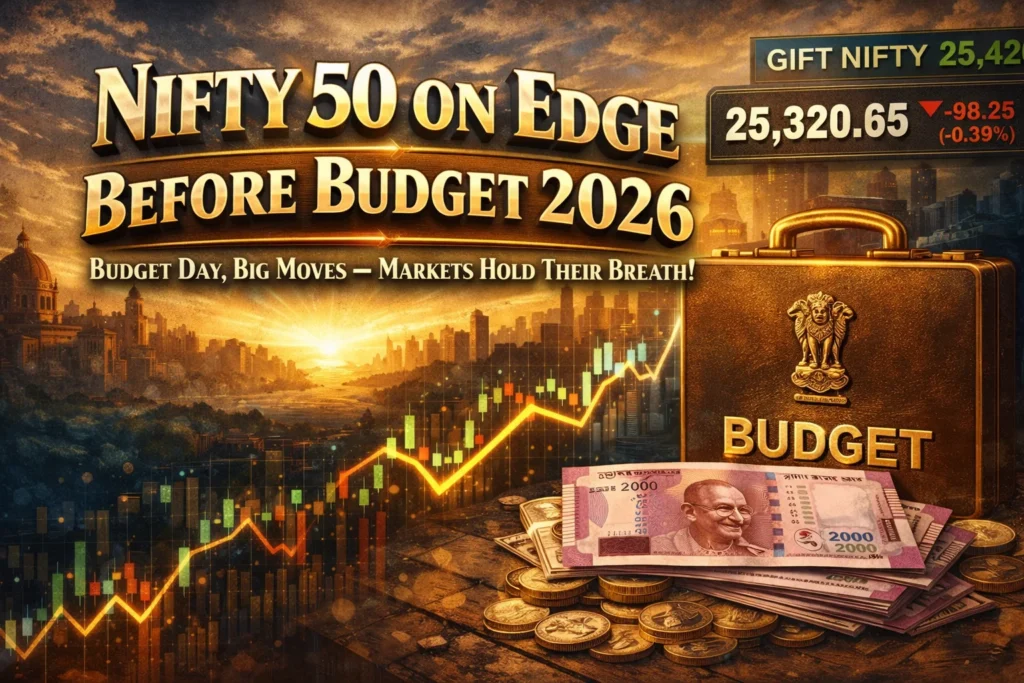
Nifty 50 on Edge Before Budget 2026

Nifty

“Budget Day, Big Moves — Markets Hold Their Breath”

The Nifty 50 ended Friday on a cautious note as investors stepped back ahead of the highly anticipated Union Budget 2026. While domestic benchmarks slipped, GIFT Nifty signals a flat-to-muted opening for Sunday, February 1, reflecting uncertainty before the Finance Minister’s big announcements.

Table of Contents

Recent Market Performance

On January 30, the benchmark Nifty 50 closed at 25,320.65, slipping 98.25 points (0.39%) from the previous close of 25,418.90. The index oscillated between an intraday low of 25,213.65 and a high of 25,370.70.

Trading activity remained healthy with volumes of 5,083.89 lakh shares and a turnover of ₹40,771.81 crore. Despite near-term pressure, Nifty has delivered an 8.91% return over the past year, though it remains down 3.16% YTD.

Key Index Metrics

  • P/E Ratio: 22.04
  • P/B Ratio: 3.44
  • Dividend Yield: 1.30%
  • Free-Float Market Cap: ₹115.17 lakh crore

Market breadth stayed balanced with 25 stocks advancing and 25 declining. Heavyweights like Reliance Industries, HDFC Bank, and Bharti Airtel continued to dominate index movement.

Market Outlook & Levels to Watch

Early Sunday trade in GIFT Nifty hovered near 25,420, hinting at a flat opening as traders await Budget cues. The index recently snapped a three-day rally due to FII selling, rupee weakness, and pressure in banking and metal stocks.

Technical levels to watch:
Support is placed at 25,200–25,300 near the 200-day EMA, while immediate resistance stands at 25,500. A decisive move beyond this range could set the tone for the coming weeks.

Union Budget 2026: What Markets Expect

Finance Minister Nirmala Sitharaman presents the Union Budget today, with investors tracking announcements on capital expenditure, tax reforms, rural spending, and consumption-led growth.

Sectors like agriculture, digital infrastructure, NBFCs, and manufacturing are in focus. Pharma and auto stocks reported mixed Q3 earnings, while metals weakened ahead of the event. Analysts expect heightened volatility but policy continuity.

Global Market Cues

Global sentiment remains mixed. US Dow futures fell 0.40% and Nasdaq futures slid 0.95%, while Europe’s FTSE gained 0.51%. Asian markets were uneven with Nikkei down 0.10% and Hang Seng slipping 1.98%.

Persistent FII outflows and global uncertainty, including developments around US Fed leadership, continue to weigh on Indian equities.

With Budget 2026 in focus, Nifty stands at a crucial crossroads. Traders should brace for sharp swings as policy announcements decide whether the index breaks higher — or slips below key support.


Disclaimer: Yeh views market experts ke hain and not of trueincome. Investment karne se pehle certified advisor se consult zaroor karein.

Read more

Why Is Indian Stock Market Falling Today?

Why Is Indian Stock Market Falling Today?Why Is Indian Stock Market Falling Today? Nifty Sinks Below 26K

Aaj Indian Stock Market mein tez girawat dekhne ko mili, jisme Nifty 50 26,000 ke niche fisal gaya aur Sensex bhi intraday trade mein lagbhag 700 points tak toot gaya. Monday ko market opening ke baad se hi selling pressure bana raha, khas kar midcap aur smallcap stocks mein heavy sell-off dekhne ko mila.

Nifty 50 lagbhag 237 points girkar 26,000 ke neeche trade karta dikha, jabki BSE Sensex 1:32 pm tak kareeb 660 points toot gaya. 1:56 pm tak Sensex aur zyada girkar 729 points neeche 84,983 ke level par pahunch gaya. Is girawat ka ek bada reason Asian markets ka weak performance bhi raha, jaise Nikkei 225 aur Hang Seng jaise indices bhi pressure mein rahe.

Midcap aur Smallcap Stocks Mein Badi Girawat
Aaj ke session mein midcap aur smallcap stocks sabse zyada suffer karte dikhe. Nifty Midcap 50 lagbhag 1.89% gira, Nifty Midcap 100 around 2% neeche raha, aur Nifty Smallcap 2.58% ke aas-paas gir gaya. Nifty Smallcap 50 bhi lagbhag 2.62% toot gaya. Iska matlab ye hai ki retail investors ke favourite stocks mein zyada pain dekhne ko mila.

PSU Banks aur Realty Sector Top Losers
Aaj PSU banks aur real estate sector market ke sabse bade losers rahe. Nifty PSU Bank index lagbhag 2.6% se zyada gir gaya, jisme Punjab National Bank, Canara Bank, Bank of India, Indian Bank aur Union Bank jaise stocks sabse zyada gire.

Wahin Nifty Realty index bhi lagbhag 3.8% tak toot gaya. Godrej Properties, Prestige, Anant Raj aur DLF jaise realty stocks par bhi heavy selling pressure raha.

Indian Stock Market Aaj Kyun Gir Raha Hai?
Experts ke mutabik, aaj market girne ki sabse badi wajah Foreign Institutional Investors (FII) ki tez selling aur global level par bani uncertainty hai. NSE website ke mutabik, India VIX intraday session mein 6% se zyada jump kar gaya, jo market mein badhti volatility ka signal deta hai.

Market expert Siddharth Maurya, Founder & Managing Director, Vibhavangal Anukulakara Pvt. Ltd. ke according, “Aaj Sensex aur Nifty mein girawat ka main reason worldwide nervous environment hai. Investors ko abhi bhi clear nahi hai ki interest rate cuts kab honge. Asian markets ka weak rehna bhi ek bada reason hai. Saath hi, pichhle kuch dino ke strong rally ke baad market ki valuations thodi mehngi ho chuki thi, jis wajah se negative news par market zyada easily react karti hai. Midcap aur smallcap stocks pehle hi kaafi tezi se badhe the, isliye liquidity kam hote hi aur profit-booking shuru hote hi yahan girawat zyada tez dikhi.”

Disclaimer: Yahan diye gaye views aur opinions individual analysts ke hain. Inka Trueincome.in se direct koi lena-dena nahi hai. Investment se pehle apni research zaroor karein.

Read more