
Tata Power Stock Jumps on ₹30,000 Cr Deal

Tata Power

Powering Growth: Big Deal, Bigger Momentum ⚡


📊 Current Price & Key Levels

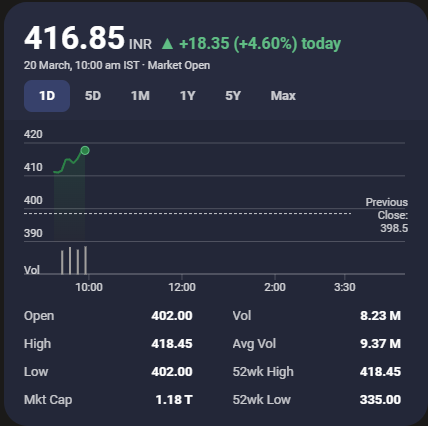
As of 20 March 2026, Tata Power’s share price is trading in the range of
₹398–₹404, showing steady strength in recent sessions. The stock recently touched an intraday gain of nearly
4%, driven by positive regulatory developments.

On 19 March 2026, the closing price stood around ₹398.50, with a day range between
₹393–₹404. The stock’s 52-week range lies between ₹326 and ₹495, with an all-time high near
₹494.85, indicating it is currently trading close to its recovery highs.
Tata Power


🚀 Big Catalyst: Gujarat PPA

The major trigger behind the recent surge is the approval of a revised
Power Purchase Agreement (PPA) for Tata Power’s
4 GW Mundra thermal plant by the Gujarat government.

This long-term deal, estimated to be worth over ₹30,000 crore, is expected to stabilize revenue streams
and improve capacity utilization. It also resolves long-standing regulatory uncertainties surrounding the Mundra project,
which had previously impacted investor sentiment.

📈 Financials & Analyst View

Tata Power’s latest quarterly results showed a slight 4% decline in revenue year-on-year, but
profit after tax improved modestly. This mixed performance initially caused a short-term dip, but the stock
quickly recovered.

Analysts remain optimistic due to the company’s strong presence in
renewable energy, smart grids, and improving margins in distribution and transmission.
Consensus price targets for the next 12 months are in the range of ₹410–₹425, suggesting limited but stable upside.

💡 What It Means for Investors

Tata Power is currently trading at a forward P/E ratio of 45–50, which appears premium compared to the broader market
but aligns with other large-cap power and renewable companies.

The stock’s short-term momentum remains positive due to the Gujarat PPA boost and strong institutional participation.
However, investors should closely monitor key risks such as:

  • Execution in renewable projects
  • Regulatory and tariff-related changes
  • Coal price volatility

Overall, Tata Power continues to show resilience, supported by strategic developments and long-term growth potential in India’s energy sector.

⚠️ Disclaimer

This content is for informational purposes only and should not be considered as financial or investment advice.
Stock market investments are subject to market risks. Please consult a certified financial advisor before making any investment decisions.


Read more

STT Shock in Budget 2026

Budget

“Speculation Gets Costlier, Discipline Gets Cheaper.”


Union Budget 2026-27 delivered a major jolt to Dalal Street as Finance Minister
Nirmala Sitharaman announced a sharp hike in
Securities Transaction Tax (STT) on futures and options.
The move triggered an instant market sell-off and reignited debate around
speculation, revenue, and retail trader protection.

📌 Table of Contents

📊 What Changed in STT?

The government announced higher STT rates across the derivatives segment,
making futures and options trading significantly more expensive.

Segment Old STT Rate New STT Rate
Futures 0.02% 0.05%
Options (Premium) 0.10% 0.15%
Options (Exercise) 0.125% 0.15%

These changes aim to discourage excessive speculation, especially among
retail traders active in F&O markets.

📉 Market Reaction: Sensex Crashes

Markets reacted instantly after the announcement:

  • Sensex plunged 1,547 points
  • Heavy selling in banking and brokerage stocks
  • F&O-heavy traders rushed to cut positions

Higher transaction costs raised fears of lower trading volumes,
especially in the derivatives segment that dominates daily turnover.

💰 Why the Government Raised STT

STT collections fell short of expectations despite booming derivatives volumes:

  • FY26 STT target: ₹78,000 crore
  • Collected till Jan 1: ₹45,000 crore
  • Estimated FY26 total: ₹57,000 crore (25% shortfall)

The hike is designed to plug this gap and extract more revenue from
high-frequency and high-volume trading activity.

🧠 Experts & Industry Reactions

Market veteran Shankar Sharma supported the move, calling
unrestricted F&O trading a “poison” for retail investors and welcoming
steps to reduce speculative addiction.

Brokers, however, criticized the hike and demanded:

  • Restoration of Section 88E tax rebates
  • Clarity on physical settlement-related STT

Some analysts believe the real target is high-frequency and algorithmic traders
rather than individual investors.

⚙️ Other Key Budget Reforms

Alongside STT changes, the budget introduced corporate tax simplifications:

  • MAT reduced from 15% to 14% (effective April 2026)
  • No new MAT credit accumulation
  • Push toward simplified new tax regime

Direct tax collections hit ₹17.78 lakh crore by February 10,
up 14.69% year-on-year, with STT collections surging 65%.

⚠️ What This Means for Traders & Markets

The STT hike could:

  • Reduce F&O volumes
  • Protect novice traders from heavy losses
  • Increase trading costs across the board

Meanwhile, the Supreme Court is examining the constitutional validity of STT,
keeping the debate alive. While sectors like electronics rallied after
₹40,000 crore allocations, derivatives markets now face strong headwinds.


Budget 2026 walks a tightrope—boosting revenue
and curbing speculation while risking short-term market volatility.
For traders, discipline just became more expensive.


Read more

Nifty 50 on Edge Before Budget 2026

Nifty

“Budget Day, Big Moves — Markets Hold Their Breath”

The Nifty 50 ended Friday on a cautious note as investors stepped back ahead of the highly anticipated Union Budget 2026. While domestic benchmarks slipped, GIFT Nifty signals a flat-to-muted opening for Sunday, February 1, reflecting uncertainty before the Finance Minister’s big announcements.

Table of Contents

Recent Market Performance

On January 30, the benchmark Nifty 50 closed at 25,320.65, slipping 98.25 points (0.39%) from the previous close of 25,418.90. The index oscillated between an intraday low of 25,213.65 and a high of 25,370.70.

Trading activity remained healthy with volumes of 5,083.89 lakh shares and a turnover of ₹40,771.81 crore. Despite near-term pressure, Nifty has delivered an 8.91% return over the past year, though it remains down 3.16% YTD.

Key Index Metrics

  • P/E Ratio: 22.04
  • P/B Ratio: 3.44
  • Dividend Yield: 1.30%
  • Free-Float Market Cap: ₹115.17 lakh crore

Market breadth stayed balanced with 25 stocks advancing and 25 declining. Heavyweights like Reliance Industries, HDFC Bank, and Bharti Airtel continued to dominate index movement.

Market Outlook & Levels to Watch

Early Sunday trade in GIFT Nifty hovered near 25,420, hinting at a flat opening as traders await Budget cues. The index recently snapped a three-day rally due to FII selling, rupee weakness, and pressure in banking and metal stocks.

Technical levels to watch:
Support is placed at 25,200–25,300 near the 200-day EMA, while immediate resistance stands at 25,500. A decisive move beyond this range could set the tone for the coming weeks.

Union Budget 2026: What Markets Expect

Finance Minister Nirmala Sitharaman presents the Union Budget today, with investors tracking announcements on capital expenditure, tax reforms, rural spending, and consumption-led growth.

Sectors like agriculture, digital infrastructure, NBFCs, and manufacturing are in focus. Pharma and auto stocks reported mixed Q3 earnings, while metals weakened ahead of the event. Analysts expect heightened volatility but policy continuity.

Global Market Cues

Global sentiment remains mixed. US Dow futures fell 0.40% and Nasdaq futures slid 0.95%, while Europe’s FTSE gained 0.51%. Asian markets were uneven with Nikkei down 0.10% and Hang Seng slipping 1.98%.

Persistent FII outflows and global uncertainty, including developments around US Fed leadership, continue to weigh on Indian equities.

With Budget 2026 in focus, Nifty stands at a crucial crossroads. Traders should brace for sharp swings as policy announcements decide whether the index breaks higher — or slips below key support.


Disclaimer: Yeh views market experts ke hain and not of trueincome. Investment karne se pehle certified advisor se consult zaroor karein.

Read more