
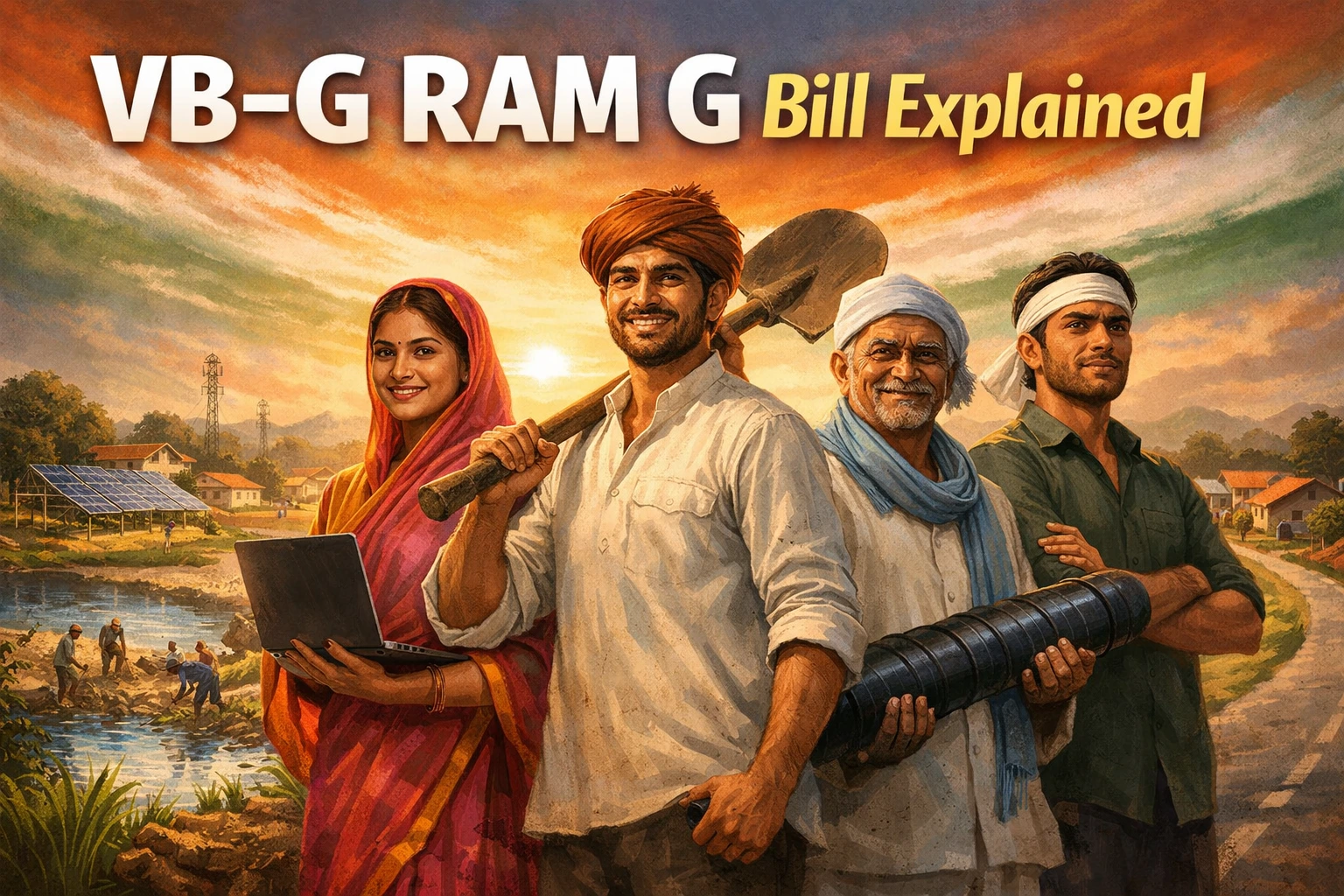
VB–G RAM G Bill Overview
The Viksit Bharat – Guarantee for Rozgar and Ajeevika Mission (Gramin), popularly called VB–G RAM G, is a newly introduced rural employment bill that has grabbed nationwide attention.
Presented in the Lok Sabha on December 16, 2025, this bill replaces the MGNREGA Act of 2005, marking a major shift in India’s rural employment policy. The aim is to modernize village-level work and align it with the government’s Viksit Bharat 2047 vision.
The bill trended heavily on December 18, 2025, mainly because of:
-
Its unusual acronym “G RAM G”
-
Heated parliamentary debates
-
Public concern over replacing a rights-based law like MGNREGA
What Changes Under VB–G RAM G?
🔹 More Guaranteed Work Days
-
125 days of wage employment per rural household
-
Earlier under MGNREGA: 100 days
🔹 Focus on Productive & Sustainable Works
Projects are grouped into:
-
Water security (ponds, irrigation, recharge)
-
Core rural infrastructure
-
Livelihood infrastructure
-
Disaster and climate resilience
🔹 Seasonal Pause for Farmers
A statutory 60-day pause during peak agricultural seasons:
-
Prevents farm labor shortages
-
Applied differently by district and agro-climatic zone
Funding and Implementation Shift
The bill changes how money flows:
-
60:40 Centre–State funding (90:10 for Himalayan & Northeast states)
-
Budget becomes normative, not demand-driven
-
States must bear extra costs beyond allocated limits
All works must come from Viksit Gram Panchayat Plans and be digitally integrated with:
-
National Rural Infrastructure Stack
-
PM Gati Shakti platform
Technology, Transparency & Monitoring
To fix long-standing issues, VB–G RAM G introduces:
-
Biometric attendance
-
Geo-tagged work sites
-
AI-based fraud detection
-
Weekly public data releases
-
Mandatory social audits
Why Was MGNREGA Replaced?
The government cited multiple challenges:
-
₹193.67 crore misappropriation (FY 2024–25)
-
Only 7.61% of households completed 100 days of work
-
Delays in payments and leakages
VB–G RAM G shifts the programme from a rights-based, demand-led model to a planned, performance-driven system.
Expected Benefits & Concerns
✅ Potential Benefits
-
Better water availability for farming
-
Reduced rural migration
-
Faster digital wage payments
-
Climate-resilient village assets
⚠️ Major Concerns
-
60-day pause may reduce real workdays
-
Financial pressure on states
-
Loss of legal entitlement nature of MGNREGA
The bill passed amid loud opposition protests, signaling a policy-heavy transformation of rural employment.
Frequently Asked Questions
❓ What is G RAM G?
G RAM G stands for Guarantee for Rozgar and Ajeevika Mission (Gramin).
It is the rural employment mission under the Viksit Bharat framework, designed to provide structured, technology-driven wage work in villages.
❓ What is a Gram/G RAM G Bill?
The G RAM G Bill is a parliamentary legislation that replaces MGNREGA and defines:
-
How rural jobs are planned
-
How many days of work are guaranteed
-
How funds and monitoring are managed
❓ Who is the old actor Ramji?
There is no official link between the VB–G RAM G bill and any actor named Ramji.
The confusion arises purely from the acronym, not from any individual.
❓ What is MGNREGA?
MGNREGA (2005) was a landmark rural employment law that guaranteed 100 days of wage employment to rural households on demand.
VB–G RAM G officially replaces this act with a planned and tech-focused approach.